Page 2 of 3
Posted: Sat Feb 16, 2008 3:08 pm
by Hawkeye
Because a pump is working slightly differently. Air is leaking past the pump head on the upstroke. When the piston starts to fill, it moves forward which is more like a downstroke.
It's very subtle difference but one which I'm pretty sure gets better results from a reversed grooved face.
A piston operates at a much more rapid pace than a pump stroke. I think the o-ring is practically left standing while the piston moves in an actual gun configuration.
The way you have it depicted relies on air acting on the o-ring just as much as the piston body.
I'd like to see how Rag has his set-up.
Posted: Sat Feb 16, 2008 4:05 pm
by Gippeto
Hawkeye:
The o-ring moves with the piston. Pressure is non-selective, it does not care what it is pushing against. The o-ring is moved with the piston by the pressure differential created when venting the pilot volume.
It is the same in your pump. The higher pressure side "pushes" toward the lower pressure side.
Posted: Sat Feb 16, 2008 4:34 pm
by Hawkeye
No , The o-ring in this application is loose so it isn't really a fixed part of the piston. It has a perfect fit with the cylinder walls so there is always a slight lag in its movement relative to the main portion of the piston.
Actually a clear cylinder might best demonstrate what really goes on.
I would say I'm 99 percent sure that when the piston starts moving back that the o-ring seals against the front of the piston, not the back.
Likewise I feel that when you pressurize from the back, the piston moves forward and the o-ring will stay towards the back of the piston if there are grooves there. If there isn't a perfect seal in that position then there wouldn't be much reason for the o-ring to be forced forward.
Again, I'm not saying it won't work the other way, I just don't think there is a gain in efficiency.
If you are right and I am wrong then my gun would not actually fill. The pressure would push the o-ring forward and seal against my solid front washer. I would only be able to fill the pilot volume. That doesn't happen.
Posted: Sat Feb 16, 2008 6:35 pm
by Gippeto
It seems as though you are assuming friction to be the major force involved in moving the o-ring.
I tactfully disagree and withdraw from further posting on this subject.
Posted: Sat Feb 16, 2008 6:58 pm
by pizlo

FIght Fight Fight!
Posted: Sun Feb 17, 2008 12:04 am
by Flash
Oh, I get it now.

And just for fun, here's a 3D animation of it.

Hey Gippeto, what material is the large, white piece made of? Is it nylon?
And Jack, wouldn't the best way to make the piston accelerate faster is make it as light and thin as possible rather than include more pieces?
Posted: Sun Feb 17, 2008 2:48 am
by Gippeto
Flash:
Very nice animations. 8)
From the piston face rearward; teflon sealing face, u-cup seal (buna), nylon sleeve (to eliminate possible scoring), an eraser as a bumper (the only material that passed my hammer test

). The piston itself is machined from 1045 steel and has been hollowed out and filled with nylon for weight reduction.
I believe Jack was trying to reduce pilot volume (a never ending quest). The inertia of the smallish piston is being used to overcome the pressure differential. For intents and purposes, a hammer valve.
I'm sure he will let us know?
Posted: Sun Feb 17, 2008 3:34 am
by jackssmirkingrevenge
Gippeto wrote:The inertia of the smallish piston is being used to overcome the pressure differential. For intents and purposes, a hammer valve.
Well spotted

it's a combination of the piston and the hammer valve concept. The thought is that in a normal piston, the instant it starts to move then the projectile has already started to accelerate but the piston isn't at maximum flow. With my proposed design, the piston is opened by a mass that is already accelerating, meaning that in theory it will open significantly faster than an ordinary piston.
As I said, in the diagram the piston appears smaller/same diameter as the barrel, but it can be wider just as a normal piston, this will only increase the momentum that opens the valve, so weight isn't as much of an issue.
Posted: Sun Feb 17, 2008 12:53 pm
by Gippeto
Ahh... grasshopper understands your thinking now!
Or at least your intention.
Posted: Sun Feb 17, 2008 5:58 pm
by Flash
jackssmirkingrevenge wrote:
As I said, in the diagram the piston appears smaller/same diameter as the barrel, but it can be wider just as a normal piston, this will only increase the momentum that opens the valve, so weight isn't as much of an issue.
Okay, so the force of the air acting on the piston overcomes its greater mass because of the piston's larger circumference.
For the animations, I just saved a view of the model I made in Google SketchUp as a PNG and uploaded it to photobucket. Then all I had to do was use photobucket's remix tool to make a slide of the the different views that I saved, each one with the o-ring in a slightly different position.
Posted: Mon Feb 18, 2008 12:41 am
by jackssmirkingrevenge
Flash wrote:Okay, so the force of the air acting on the piston overcomes its greater mass because of the piston's larger circumference.
A small, lightweigh piston is a good idea because it will accelerate faster, no doubt about that - for a given force, the lower the mass then the greater the acceleration.
In my design however, the piston will start to accelerate without opening the piston instantly.
This is the firing sequence, I'll animate it when I get home:
Posted: Mon Feb 18, 2008 12:29 pm
by Gippeto
How about this for a primary piston?
Posted: Mon Feb 18, 2008 12:58 pm
by Ragnarok
Hawkeye wrote:I'd like to see how Rag has his set-up.
Top secret I'm afraid, only one photo I can find:
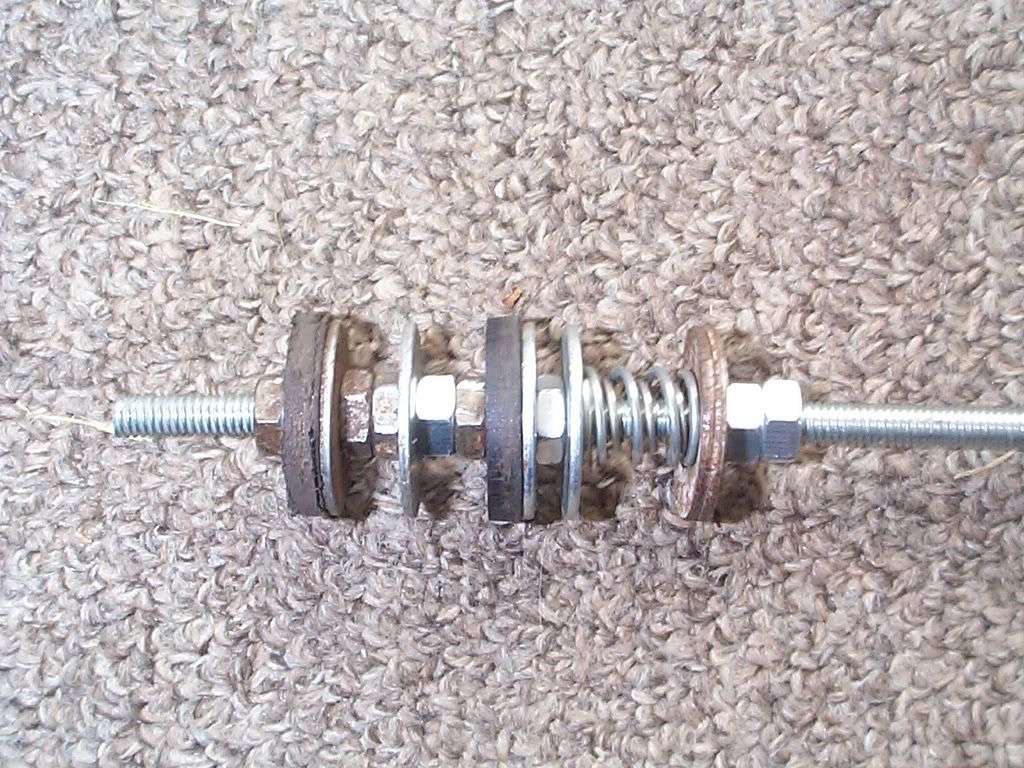
That was before the threaded rod was cut to length, or even before the nuts were tightened. The rubber washer in the middle, when squashed out slightly acts as a check valve, not too unlike the bike pump variety - pushed forwards (and open) by air from behind, pushed back and seals when being fired.. Practically no blow-by to speak of.
It's since had an overhaul - been lightened by trimming bits out of some washers, uses thinner nuts to lose weight, lower pilot volume and has tougher recoil springs, because the last set came out looking like pancakes, even having been aided by a thick rubber bumper - the peak force on it from the pressure is far greater than my weight.
Posted: Mon Feb 18, 2008 1:01 pm
by Maniac
How much do you weigh?

Posted: Mon Feb 18, 2008 1:10 pm
by Ragnarok
Maniac wrote:How much do you weigh?
Right now? Around 70-75 kilos, which is roughly 160 lbs. But the peak force on the piston is over eleven hundred Newtons, about half as much again as my weight - a lot on something that weighs under 2 ounces.
It may not be a large piston, but the 300 psi pressure puts a lot of force on it.