Page 2 of 2
Posted: Thu Jul 30, 2009 2:28 pm
by Technician1002
POLAND_SPUD wrote:well I wasn't referring to the back pressure only... I meant that turning them on/off all the time puts more wear on the parts and the motor
I am not saying that you have to get a tank... I am only suggesting that it makes life easier in the longer run...
I usually start the compressor under no load as I have two ball valves on the setup.. one between the tank and the compressor and one for venting the volume between the tank and the compressor..
so actually I can close off the tank, vent the air that on the air output, turn the compressor on and then open the tank (it's usually already at 250 psi as I see no point in venting it after each use) and I have lots of air at hand, which translates to -> no waiting
There is no real wear issue with start stop.. It tends to eat the contacts in the start relay. Many AC motors are built for constant start stop operation including machine tools and elevators.
Refrigerators don't like it due to the heat build up from repeated use of the high current start up and high head pressure. The motor in the can isn't very well cooled for repeated short cycling.
Posted: Thu Jul 30, 2009 3:26 pm
by POLAND_SPUD
@ tech your reply supports my reasoning so what's the point in it ?
Posted: Thu Jul 30, 2009 4:25 pm
by boyntonstu
Technician1002 wrote:boyntonstu wrote:
The capacitor is definitely a run capacitor. Since it was connected with only 2 wires, it seems that the wiring is complete.
BoyntonStu
What's so hard at looking at the side of the compressor under the little cover?
The difference in a run and start capacitor besides the size is the presence or absence of a relay ON THE SIDE of THE COMPRESSOR that disconnects the capacitor after the compressor starts.
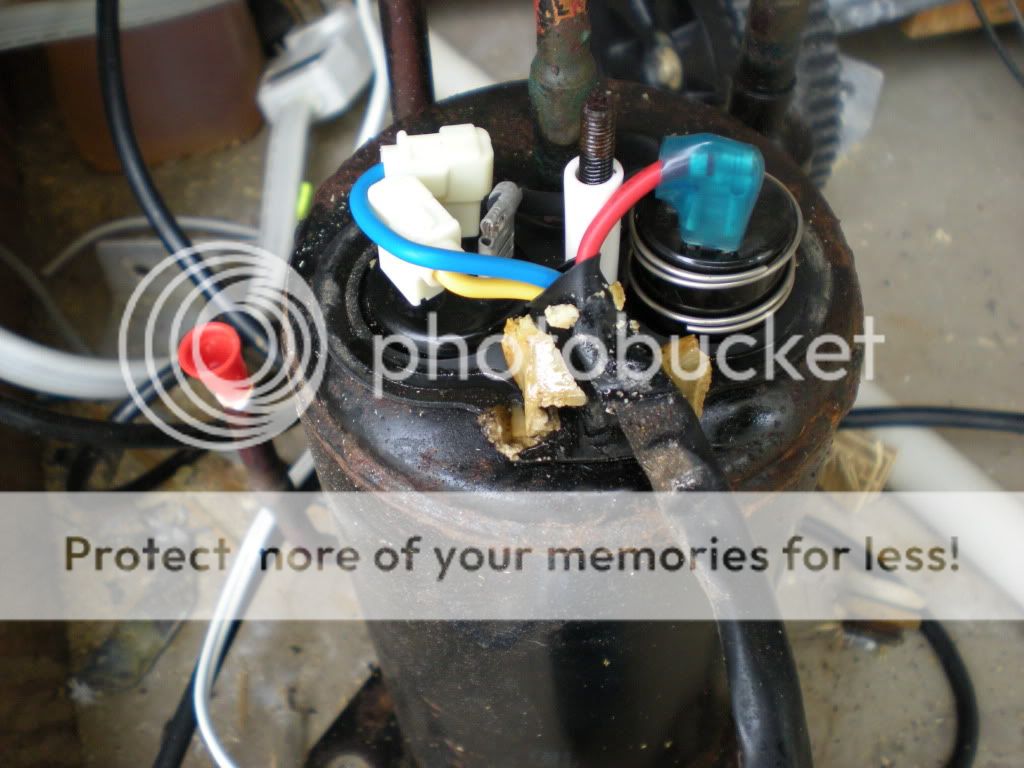
It is true there are two leads that connect to POWER. Between the capacitor and motor is 3 leads.
On the leads shown here;

BLUE is the RUN. It connects to both the RUN on the compressor through the coil on the relay if one is present and POWER on the capacitor.
RED is COMMON. It connect to the common terminal of the compressor.
Grab a pic of the connections on the compressor itself. Most often the relay is disguised as a plug that attaches to the terminals of the compressor. If you didn't remove it, it if it exists, is still on the compressor.
Yellow is EITHER START or RUN CAP. To tell, you have to take the cover off the compressor and look for a START RELAY.. What is so hard about looking under the cover? I suspect the yellow wire connects to a terminal on a relay under the cover. Until someone looks there is no way to tell what is under the cover.
Under the hood:
http://i348.photobucket.com/albums/q339 ... top001.jpg
I intend to reuse the empty dryer as a tube air filter.
http://i348.photobucket.com/albums/q339 ... top002.jpg

BoyntonStu
Posted: Thu Jul 30, 2009 4:30 pm
by Technician1002
boyntonstu wrote:Technician1002 wrote:boyntonstu wrote:
The capacitor is definitely a run capacitor. Since it was connected with only 2 wires, it seems that the wiring is complete.
BoyntonStu
What's so hard at looking at the side of the compressor under the little cover?
The difference in a run and start capacitor besides the size is the presence or absence of a relay ON THE SIDE of THE COMPRESSOR that disconnects the capacitor after the compressor starts.
It is true there are two leads that connect to POWER. Between the capacitor and motor is 3 leads.
On the leads shown here;
BLUE is the RUN. It connects to both the RUN on the compressor through the coil on the relay if one is present and POWER on the capacitor.
RED is COMMON. It connect to the common terminal of the compressor.
Grab a pic of the connections on the compressor itself. Most often the relay is disguised as a plug that attaches to the terminals of the compressor. If you didn't remove it, it if it exists, is still on the compressor.
Yellow is EITHER START or RUN CAP. To tell, you have to take the cover off the compressor and look for a START RELAY.. What is so hard about looking under the cover? I suspect the yellow wire connects to a terminal on a relay under the cover. Until someone looks there is no way to tell what is under the cover.
Under the hood:
http://i348.photobucket.com/albums/q339 ... top001.jpg
I intend to reuse the empty dryer as a tube air filter.
http://i348.photobucket.com/albums/q339 ... top002.jpg
BoyntonStu
Well done. No relay, only a thermal cut out on the common lead. That is indeed a run cap.
EDIT..
If you work in the field an easy way to tell is to grab a clamp around (Amp Clamp) ammeter. A run cap has current when running and a start cap current drops to zero after starting.
Posted: Thu Jul 30, 2009 5:08 pm
by POLAND_SPUD
I am going a bit off topic now... but would it be possible to use an AC or fridge compressor as a heat pump for heating, for example, a house??
ok I know it is possible but would it be practical to attempt this ?
Posted: Thu Jul 30, 2009 5:23 pm
by Technician1002
POLAND_SPUD wrote:I am going a bit off topic now... but would it be possible to use an AC or fridge compressor as a heat pump for heating, for example, a house??
ok I know it is possible but would it be practical to attempt this ?
Yes.. As long as your house isn't much bigger than a refrigerator.
The long explanation.. Compressors come in two basic varieties.. Low temp and high temp.
The difference is the displacement of the piston to match the expected intake pressure. Low temp for freezers has a small motor but large displacement for the low inlet pressure. High temp units for a window air conditioner is expecting the return gas to arrive at a higher pressure, so they have a smaller displacement (assuming the same HP size). Due to the BTU load of a house, the motor and compressor is much larger for AC units.
Using a fridge compressor for a heat pump will overload it with higher than expected gas volume from the high temp coil and it would be too small to move many BTU's.
An AC pump will work but will be limited in capacity as the original air conditioner. You will need some check valves and a reversing valve and an accumulator along with some engineering.
In heating mode, much of the Freon will be liquid as everything is at a lower average temperature and may appear flooded. In cooling the average temperature is higher and therefore appear to have less liquid. The accumulator is to store liquid when needed for the transition between heating an cooling.
Posted: Thu Jul 30, 2009 6:47 pm
by POLAND_SPUD
thx tech.. I was expecting this
Posted: Thu Jul 30, 2009 7:36 pm
by jackssmirkingrevenge
Technician1002 wrote:Yes.. As long as your house isn't much bigger than a refrigerator.
Well, if what they say about Poland is true


Posted: Thu Jul 30, 2009 8:36 pm
by POLAND_SPUD
@JSR yeah poland it's more less the same as Kazakhstan... would you like me to post some pics of me with my sister? she's nice
Posted: Fri Jul 31, 2009 12:03 am
by jackssmirkingrevenge
hahaha is she "number four prostitute in all Poland"?
My sister isn't bad either, how about an intercultural exchange?
Posted: Fri Jul 31, 2009 1:36 am
by POLAND_SPUD
Looks like we've got a deal...
if she's a redhead I'll send you an extra fridge compressor for free
Posted: Fri Jul 31, 2009 1:56 am
by jackssmirkingrevenge
Check your PM

also, your sig needs a
link