Page 2 of 2
Posted: Sun Sep 13, 2009 11:31 pm
by THUNDERLORD
...As Tech pointed out above, it was less to do with the high pressure and more to do with the fact that in an oxygen rich environment, any solvents present in the firing mechanism of the airgun would have become highly explosive, it's an accident waiting to happen.
Looks too powerful/rapid even for controlled use in a hybrid cartridge,
it could have two chambers seperated by a burst-disc,
One with a drop of gas or oil, Other high pressure oxygen,
And a pin to rupture the burst-disc between?
D*mn shame (word of the day) it wouldn't have needed any spark (?)
Guess now I know why the automotive world uses more expensive N2O rather than cheaper oxygen for racing! 8)
Posted: Sun Sep 13, 2009 11:43 pm
by Technician1002
THUNDERLORD wrote:...As Tech pointed out above, it was less to do with the high pressure and more to do with the fact that in an oxygen rich environment, any solvents present in the firing mechanism of the airgun would have become highly explosive, it's an accident waiting to happen.
Looks too powerful/rapid even for controlled use in a hybrid cartridge,
it could have two chambers separated by a burst-disc,
One with a drop of gas or oil, Other high pressure oxygen,
And a pin to rupture the burst-disc between?
D*mn shame (word of the day) it wouldn't have needed any spark (?)
Guess now I know why the automotive world uses more expensive N2O rather than cheaper oxygen for racing! 8)
Most people don't realize many items become explosive in an oxygen enriched environment. I have seen a small torn off piece of notebook paper explode. It was dipped in liquid oxygen and then hit with a hammer. It went off like a cap gun. We though the cryogenic temperature would have prevented compression ignition. We were wrong. A hot engine, hot oiled parts, carbon, flammable vapor, and oxygen enrichment is a formula to grenade the engine.
This oxygen regulator is fried because the tube was ignited by a smoker on oxygen. The tube burned so hot in the rich oxygen environment, it continued to burn the regulator. The smoker was seriously injured. See any similarities between this and the other oxygen enriched fire? The other one had a compression ignition possibly resulting in an explosion and fire.
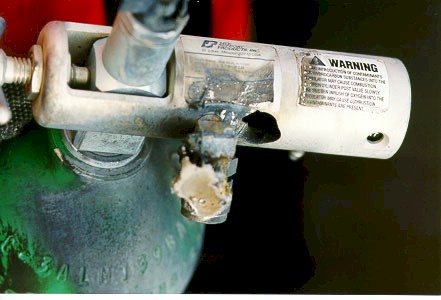 http://stanford.wellsphere.com/asthma-a ... lly/296297
I don't use oxygen for anything other than what it was intended for because it's way too dangerous. I use it for welding and nothing else.
EDIT; Pics of the regulator before the fire is here along with a couple other regulators that appear to have burned longer.
http://www.astm.org/SNEWS/ND_2008/chiff ... _nd08.html
Posted: Sun Sep 13, 2009 11:58 pm
by inonickname
world uses more expensive N2O rather
Nitrous oxide is easier to liquefy and therefore can be stored much more efficiently which is why it is used. In automotive use the pressure is much lower, so of course the risk is lower.
Smokers with lung cancer commonly die in oxygen tents from trying to smoke in them. Things burn literally at least 5 times as fast and aggressively, moreso in a pressurized environment.
Posted: Mon Sep 14, 2009 12:14 am
by D_Hall
Another benefit of nitrous oxide is that at room temperature it isn't actually an oxidizer. Nitrous must first be heated to something like (going from memory so don't quote this number!) 350 degrees before it decomposes into [mumble] and oxygen. At that point, it's a great oxidizer!
The point being that an oxygen leak can be very bad news whereas a nitrous leak is much less likely to have something go badly sans some sort of containment where it can be heated.
Posted: Mon Sep 14, 2009 1:22 am
by Moonbogg
Yeah it can be dangerous under many circumstances. I am suprisingly comfortable using it with the regulator it came with and at low pressures in the hybrid chamber, thats with a nicely greased piston. I was even so suicidal as to use it with a standard dry gage! I am under the impression that if a fire occurs at low pressure, the hose will burn and then thats about it. From the reading I have done autoignition takes place under only serious pressures and only with certain materials. At low pressures any risk appears to be reduced to possible fire. Thats pretty crazy that in one of those pics the fire was hot enough to burn right through the steel regulator.