Posted: Thu Sep 17, 2009 3:19 pm
while this is true it was my first cannon off of plans from MrCrowley, i didnt know how loud it would be when i was building it, but i do enjoy the report, my land lord just doesnt
Proper high speed valves do tend to go off with a bang. They are quieter at much lower pressure. Try it when at home on 10-25 PSI and see if it appears more sane to your landlord. It will still pack a punch. On my large cannon very low pressures are still fun and not nearly as noisy.Northir wrote:while this is true it was my first cannon off of plans from MrCrowley, i didnt know how loud it would be when i was building it, but i do enjoy the report, my land lord just doesnt
More or less what I was going to say.jackssmirkingrevenge wrote:A smaller chamber and longer barrel will cut down significantly on noise. Given the size of your launcher, the volume of silencer needed to adequately reduce noise levels would result in the cannon being somewhat clumsy. Still, a reasonably sized can on the muzzle end will take the edge off the muzzle report and make the noise more "socially acceptable" so to speak.
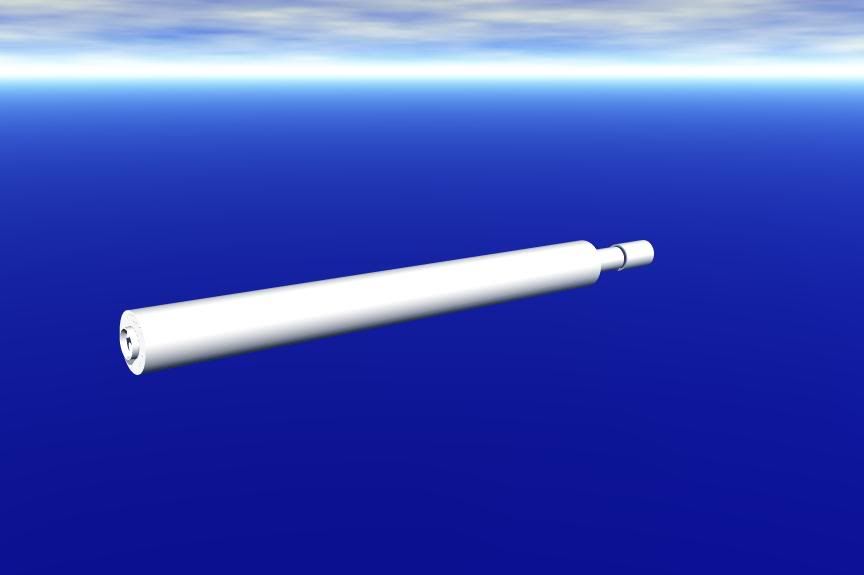
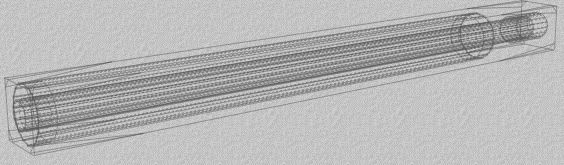
Northir wrote:maybe with insulation inside or something else to absorb the sound
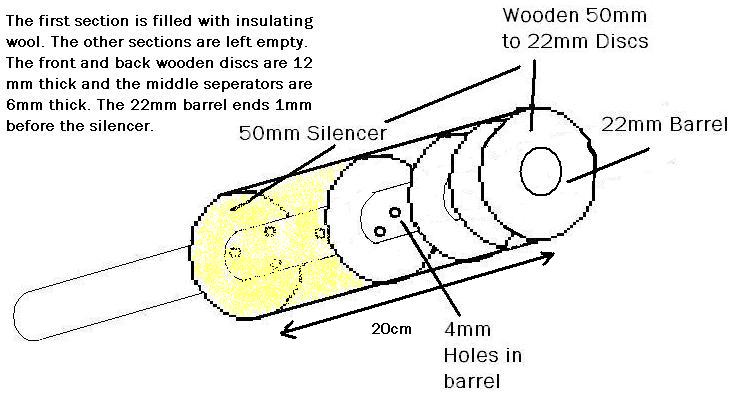
 ) spaced out as baffles to make it multi-chambered and more effective.
No no no a thousand times NO!Northir wrote:thats pretty close to what i was thinking, should i have holes in the outer section?
The point of a suppressor is that the air expands in a confined place, losing pressure in the process, before it exits to the atmosphere. With holes in the outer tube, it's going straight to the atmosphere so the suppressing effect is lost.Northir wrote:i was thinking "Where does the air go" thats where i got the idea
anyways, i have my inner barrel half drilled out just need to find my 1/8 bit, i spaced them about a 1~1 1/2" apart then staggered
This is usually done with ported rifled barrels where the holes are drilled within the rifling grooves as in the Russian VSS short range sniper rifle:now that i look at it it kinda looks spiraled around, not sure if thats a good or bad thing

Works for powder burners too:D_Hall wrote:I used to have a 450 fps golf ball gun that wasn't any louder than a conversation. Really, it was *quiet*. Only reason? Long barrel.
Silence without silencer
Sometimes the muzzle-blast is a "whisper" even without presence of suppressor device. .22 rimfire rifle with an extra-long barrel (length more than 600 mm / 23 ½") can be very quiet, when loaded with CB Short or Long cartridge, also known as ZIMMER-load or simply Z-cartridge. German word "Zimmer" means "room" or "indoor". Z-loads are intended for gallery practice, but they are useful for pest control or even for small-game hunting. Light bullet, with muzzle velocity not very much more than 200 meters per second, is more lethal than most of peoples dares to believe - or even to dream !
Original Z-loads hadn't powder charge at all, but just a priming pellet slightly more powerful than needed for normal rimfire cartridges. Frenchmen FLOBERT and HOULLIER developed the first versions of them, BB-caps, CB-caps and Bosquettes, during the first half of 19th century. Usual .22 Short or Long Rifle standard velocity cartridge, with a nominal muzzle velocity ca. 340 to 360 meters per second, may be quiet when shot from some rare .22 rifle with a VERY long barrel.
A quiet old "Long Tom"
Finnish Army used some decades ago .22 rimfire rifles, exclusively chambered either for LR or Short cartridges, with barrel length almost amazing, 825 millimeters (32 ½ inches!) When loaded with standard velocity.22 LR Vostok cartridges or Lapua Championships (nominal muzzle velocity ca. 340 m/s), the muzzle blast was as noisy as that of SHERIDAN's compressed-air rifle, pressurized with five or six pump piston strokes. Bullet's flight noise was always absent.
Reduced pressure AND velocity
When loaded with .22 Short cartridge, made for Olympic Pistol shooting (= Rapid Fire Match), the hit of "Long Tom's" heavy striker was a dominant sound. Then came snap of bullet from direction of the target. It was also possible too see, even without magnifying optical sight, the slowly flying bullet. Nominal bullet's muzzle velocity of these .22 Short Pistol Match cartridges was 310 m/s, shot from 4" test barrel.
Author hadn't yet the chronograph in late 70s, when he became acquainted with that rare variation of Mosin-Nagant model 1891, but velocity of bullet might be approximately equal with that of similar .22 Winchester Long-Z bullet, shot from usual rifle barrel; length 20 to 22 inches.
Extra barrel length = a suppressor
Extra ten inches or one full foot of barrel and bore length is able to act as a suppressor. Volume of the extended bore shall lessen the pressure of powder gasses emerging muzzle. Friction between rifled bore and the bullet slows down muzzle velocity; Q.E.D...
When using Standard Velocity .22 LR ammo, the bullet velocity is increasing to ca. 400 mm (16") distance from the chamber, but after passing this culmination point, is the velocity decreasing, because bore friction shall overcome the thrust of powder gasses, pushing the bullet towards gun muzzle.
Bore pressure is decreasing, because volume of the bore behind the bullet is expanding and temperature of gasses is declining. Barrel metal absorbs the heat, and rapid decrease of the bore pressure cools also powder gasses down. "Diesel Effect" can be reversed too..!
I use split dowel on a rod with stick on sand paper. It works nice.Northir wrote:well doubled the amount of porting, will have to wait till tomorrow to get the fittings ill need, just need to figure out how to sand the inside of the barrel