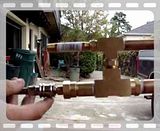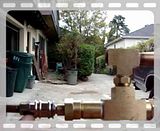

that is a great point which i didnt think of at first, did you cast that piston? or did you machine/ shape it from a bigger block. since you said you cut it off, you may want to cast your next one.Technician1002 wrote:I have a couple comments.
To get it to stop leaking out the barrel, the sealing surfaces must be true. When the surface looks like a hand carved piece of rubber without a smooth flat surface, the irregularities will provide ample room for air to leak through the low places. Placing the piston in a drill press and dressing the face to be true to the valve seat may help this issue. I have hand lapped some pistons to a valve seat in some of my cannons. Two that I have built with hand lapped piston faces include the Dragon and the Mouse Musket. They are 1 inch and 2.5 inch valve seat PVC piston coaxial cannons.

like that^^
make sure you place it on a flat surface (tape down) and make sure you cut the PVC true. the only issue with hot glue (as you may know) is air bubbles. i have no idea hot to avoid them and they may be a bit of an issue as they ass bumps to you piston face where air can escape. a bit of a tip, if you want to do something with it, like drill a hole or something, of you you are just inserting it into a tight spot, chuck it in the freezer for 20 mins, comes out a lot harder.
personally, after much experience with hot glue (i would say a good 5-10% of my last cannon is hot glue) i would use something else as a sealing face. i used hot glue for my piston and a 2.5mm thick rubber sheet which i cut into a disk for my cannon as hot glue didn't seal for me (low pressure gun).