A proper chopper circuit to pulse the primary with a tuning capacitor can run the flyback transformer in it's original designed flyback mode.
A transistor is turned on for a short duration allowing primary current to build, and then when it is turned off, a flyback cap and diode produces the high voltage pulse in the primary.
From a Wikipedia article;
The primary winding of the LOPT is driven by a relatively low voltage sawtooth wave, which is ramped up (and sweeping the beam across the screen to draw a line) and then abruptly switched off (and causing the beam to quickly fly back from the right to the left of the display) by the horizontal output stage. This is a ramped and pulsed waveform that repeats at the horizontal (line) frequency of the display. The flyback (vertical portion of the sawtooth wave) is extremely useful to the flyback transformer: the faster a magnetic field collapses, the greater the induced voltage. Furthermore, the high frequency used permits the use of a much smaller transformer. In television sets, this high frequency is about 15 kilohertz (15.734 kHz for NTSC), and vibrations from the related circuitry can often be heard as a high-pitched whine. In modern computer displays the frequency can vary over a wide range, from about 30 kHz to 150 kHz.
This transformer is not driven with a voltage sawtooth wave. It is driven by a nearly square wave in voltage. The duty cycle is slightly less than 50%. The drive consists of the following cycles. The current is a sawtooth. The high voltage is during the sharp change on the edge of the sawtooth as there is a rapid change in current. Rate of current change and voltage are directly related.
1 Transistor ON. Drive the CRT beam from the center of the screen to the right side. The ramp in current is due to inductance. There is not an applied sawtooth voltage waveform. The transistor is simply switched on. The current ramps due to inductance from zero to the amount required to reach the end of the sweep, then it is turned off.
2 Transistor OFF. Flyback portion. Voltage in the primary spikes due to the sudden loss of current. The rate of collapse is controlled by the capacitor on the primary. Current collapses to zero and the scan returns the center of the display.
3 Transistor off, at the time the current reaches zero, the flyback capacitor is charged. It begins to discharge back into the coil reversing the current. This continues the retrace portion of the scan. Beam moves to the left edge of the screen as current peaks in the reverse direction. Steps 2 and 3 happen very fast and take little time.
4 Flyback diode conducts. Current in the coil decays to zero. Scan beam moves from the left edge to the center as sweep current returns to zero.
Cycle repeats.
A typical sweep circuit voltage waveform looks like this. The positive high voltage portion is when the transistor turns off. This is the retrace. The trace portion looks flat in relation to the retrace. Diode conducts after the pulse and continues mid trace, then the transistor turns on from mid trace until the turn off which starts the retrace pulse.
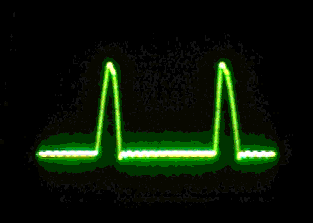
This is seldom checked with a scope as the probe will change the tuning and may cause failure.
More on the subject is in this PDF.
http://www.repairfaq.org/sam/reppic/horiz-tv.pdf