Page 2 of 4
Posted: Sun Mar 20, 2011 4:26 pm
by Technician1002
The bumper needs to deform while slowing the piston. Do you think polyurethane will compress well enough to do the job?
Posted: Sun Mar 20, 2011 4:42 pm
by drex
To be honest I'm not sure, Its very soft and, soft enough that i have to freeze it with dry ice before I machine it. but now I'm thinking i should use a more standard solution to it just to be safe, I'm not really concerned about the the valve itself breaking from the piston as the back is made of lexan over .800" thick, but I am worried that the piston itself will not hold up.
Posted: Sun Mar 20, 2011 8:31 pm
by Gun Freak
Stick with a tennis ball.
Posted: Sun Mar 20, 2011 10:21 pm
by mark.f
My solution is usually sheet rubber 1/4" thick or more (more for heavier and larger pistons). Multiple layers of 1/8" can be combined to get the thickness desired.
Posted: Mon Mar 21, 2011 9:11 am
by Gun Freak
How compressable is sheet rubber? A bumper is worthless if it can't compress, other than it limits piston travel so the piston doesn't hit as hard.
Posted: Mon Mar 21, 2011 9:59 am
by Gaderelguitarist
I use the same bumper on my piston valve as Mark, and it holds up fine. I never use the thing in temperatures below 70, though I never really want to go outside unless that temperature is met. It is a 1 1/2" piston from solid UHMW in a PVC valve housing.
Polyurethane would make a functional bumper. It is actually very commonly used for bumper applications as it has a high shock resistance. Please don't throw a mangled tennis ball into that beautiful valve.
Posted: Mon Mar 21, 2011 10:03 am
by Technician1002
Rubber works if it is not filling the space completely. The rubber MUST be able to deform to function as a bumper. A doughnut around the pilot hole works as well as flat rubber on a corrigated surface. Rubber defoms to work as a bumper. As a solid flat surface, it is not very compressable and would work as well as a block of ice.
Posted: Mon Mar 21, 2011 10:11 am
by Gaderelguitarist
So if he machines a tapering doughnut of polyurethane with a constant inner diameter hole and a tapering outer diameter, that would function as an ideal bumper since it could compress much more than a solid chunk.
Posted: Mon Mar 21, 2011 11:13 am
by Technician1002
It may work as "an ideal bumper" if it is not over deformed and becomes a one time use crumple zone bumper. An ideal bumper will have the same properties before and after use.
Posted: Mon Mar 21, 2011 11:39 am
by MRR
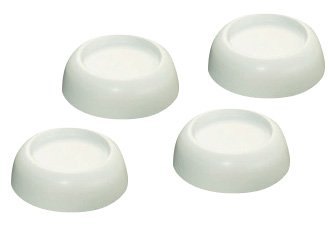
I've been in the DIY store the other day and came across these vibration damper for bath tubs and washing machines. You should check them out, they are not too hard but still very durable.
Posted: Mon Mar 21, 2011 11:40 am
by Gaderelguitarist
I would venture to say that a bumper made from polyurethane in that shape would not be a one time use endeavor. I'm on the lazy side, so I won't draw a picture, but essentially the bumper from the side would be a...
/| |\
With the tops of the two peaks much less actue and rounded, pointing towards the piston. The taper would more easily deform, but would also more readily disperse the impact into a larger mass. As long as he doesn't make the walls of the bumber less than 3/8", I don't see it deforming beyond use.
Posted: Mon Mar 21, 2011 7:19 pm
by drex
got it all put together today minus the bumper . attempted a small test fire but it would all go out the exhaust valve and the piston would only move back ~1/16" or so, im not sure whats going on there, I may have to make a new piston with orings and a check valve.
Posted: Mon Mar 21, 2011 7:46 pm
by mark.f
Where the piston seals against, is there a raised lip slightly larger than your outlet port ID, or does the piston sit flat against the end of the valve casing? (i.e. the piston's front is completely in contact with the valve housing with no surface area for air pressure to act against.)
I think this is your problem. It should be as simple as adding a lip for the piston to seal against.
Gun Freak wrote:How compressable is sheet rubber? A bumper is worthless if it can't compress, other than it limits piston travel so the piston doesn't hit as hard.
The rubber works to absorb the impact of the piston. Also, it spreads the energy of the piston over the entire surface area of the rear plug. Piston travel should be limited to what is strictly necessary in the first place through the design of the valve, especially if you're machining the valve out of solid PVC.

Tennis balls do work exceptionally well, though. I've used them in my first 1.5" port piston valve up until I started building smaller ones about two years ago.
Also, sheet rubber can be used to limit piston travel quite nicely. The attached setup works quite well for keeping my piston from exiting the rear of the copper tube inside the tee (and excess wear on the o-ring).
Posted: Wed Mar 23, 2011 5:47 pm
by drex
turned an 1/8th" lip on the piston, added an o ring and used a grease fitting as a check valve. even with only a 1 foot long 2" test chamber at 90 psi. it was incredibly loud. I cant wait to put this on a gun.
Posted: Wed Mar 23, 2011 7:54 pm
by mark.f
Very nice. I'm glad you ignored my retarded and difficult suggestion and added the lip to the piston instead of the valve housing. Never thought of that.