Page 3 of 4
Posted: Tue Dec 09, 2008 4:07 pm
by jackssmirkingrevenge
I don't know, my practical experience shows a muzzle energy increase of more than 50% for the burst disk. Granted, the piston was piloted by a schrader, but we're talking of a 1/2 inch piston with very limited travel.
Posted: Tue Dec 09, 2008 4:32 pm
by Lentamentalisk
Helium really isn't that expensive. I looked into how much it would cost me to fill one of those gigantic 5' tall tanks (that my friend is willing to lend me) from the local welding shop, and they said $80 to fill it to 2000psi. Now I realize the tank probably would cost you a good $1000 to buy new, but you can figure something out. Besides, switching to helium would have a much higher effect on projectile speed (especially for the lighter ammo) than any of your other modifications.
Posted: Tue Dec 09, 2008 4:39 pm
by POLAND_SPUD
Whats the point of building one of the best pneumatic spudguns in the world (possibly the most powerful one of its size) when you know that someone who smacked a bit more money on the project would outperform you?
And on such high speeds, 2% is alot.
I don't doubt it might be a lot and I get your point... the question is wouldn't it be better and cheaper to up the pressure or use helium?? since he is going to turn the gun into a semiauto later he has to scrapp the barrel (or some other part...)
so why bother about it now if there are other ways to increase performance??
Posted: Tue Dec 09, 2008 4:44 pm
by ALIHISGREAT
POLAND_SPUD wrote:Whats the point of building one of the best pneumatic spudguns in the world (possibly the most powerful one of its size) when you know that someone who smacked a bit more money on the project would outperform you?
And on such high speeds, 2% is alot.
I don't doubt it might be a lot and I get your point... the question is wouldn't it be better and cheaper to up the pressure or use helium?? since he is going to turn the gun into a semiauto later he has to scrapp the barrel (or some other part...)
so why bother about it now if there are other ways to increase performance??
i'm guessing he will use a modular system so he won't need to scrap the barrel.
personally, i would just up the pressure... but thats just me!
Posted: Tue Dec 09, 2008 5:28 pm
by Ragnarok
@Jack: Well, based on the cannon's dimensions, even under ideal conditions, I can't hope to better 42% efficiency, or 950 Joules (700 ft-lbs) at 500 psi - that assumes a perfect valve with zero pressure drop across it, and an ideal, frictionless and massless gas.
In the "real world", and modelling with a 20 gram projectile, a pretty typical mass for my ammo, both a piston valve and a burst disc give me results slightly below 240 m/s (~780 fps). The opening time differences in the valves create insignificant changes, and the flow differences aren't making enough difference for it to be worth the extra effort or loss of ROF.
@Poland_Spud: Ali is exactly right, nothing is being scrapped between the stages. The cannon will have interchangeable breech load and semi-auto configuration.
Even then, if it
were a one or the other situation, I can just lift the barrel out of the breech loader, and slot it straight into the semi-auto loader.
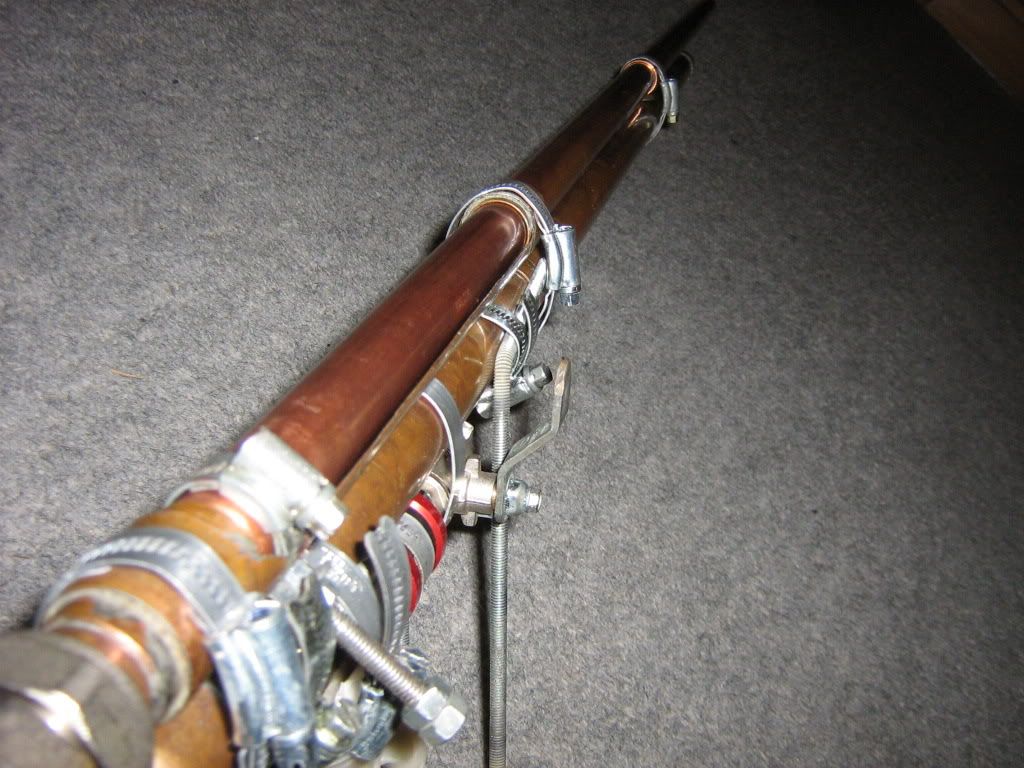
Take a look at this picture of HEAL - I undo the screw on the Jubilee clip at the back of the barrel, and I can slide the whole barrel, which (at this time at least) was no more than a plain 120cm piece of copper straight out forwards, and it never has to be scrapped. Only bit that would have to go would be the outer shell of the breechloader, which would have no particular value - couple of fittings and an O-ring (at least, on 3vo).
As for the helium issue, have several reasons I don't want to use it:
1) I have nowhere I can safely store a large high pressure gas bottle such as that for long periods of time.
2) I have no plans to go supersonic on a regular basis. Sonic shockwaves are not likely to go down well in my neighbourhood.
3) Transonic or supersonic with helium is just too easy, and therefore not particularly interesting to do.
4) Due to a low particle size, it's the fastest leaking gas. I don't intend to have a leaky cannon, but nothing is ever perfect.
Also cranking up the pressure further than 500 psi is not something I'm going to do, because I simply do not have the materials to handle any more pressure than that in a cannon.
... Lastly, even if I were going to use helium, then both helium and a Teflon coated barrel together would get even better results.
Posted: Tue Dec 09, 2008 5:38 pm
by Hotwired
It occurs to me that I've never actually heard of a PTFE coated barrel.
On bullets yes, to help lower wear of barrel rifling and even as coatings on slug type projectiles.
Given that the inside of a long barrel is a PITA to coat with anything let alone PTFE I'd rather go for coating/jacketing the projectile while using a polished and lubricated barrel.
Posted: Tue Dec 09, 2008 9:59 pm
by FordGtMan
That's not what I'm talking about. I personally cut my pipes with a mitre hacksaw, which leaves clean, square and unobstructed ends on the pipe, unlike a pipe cutter.
Copper pipe fittings are internally shaped in a way that does not sit flush with a square end on the pipe. This means that there are flow diameter changes and hard edges exposed - even on a perfectly cut pipe end - through fittings, and thus flow eddies. I intend to use a putty to fill any flow diameter increases above the normal pipe bore, and thus get a cleaner flow through a single diameter... if that still makes no sense and you're really stuck, I'll make a diagram.
Ahhh, i see. Didn't read that correct at all. Good luck getting your finger in those fittings, or will a tool be used?
Posted: Wed Dec 10, 2008 11:27 pm
by Ragnarok
I'm currently designing a new suppressor to go with this cannon, because although I have a gentleman's agreement with my neighbours regarding reasonable noise, I don't really want to be pushing it much further (as 500 psi will add a lot of noise over what I'm currently using), and I also can't account for anybody else in the area during my shooting sessions not being alarmed.
The issue at hand is that building a suppressor of the cubic volume that would be what I'd like to have from a suppression view point is somewhat impractical from other view points, so I'm trying to think of other options, based on audio soundproofing rather than just firearm moderators.
Aside from just the conventional "Stuff it with sound insulation" and "Slow the gases as much as possible", which can go only so far, I'm considering the possibility of fitting all the hard internal surfaces of the suppressor with a rubber surface layer to help reduce noise levels by absorbing sound waves.
Suggestions and criticisms needed.
Posted: Wed Dec 10, 2008 11:46 pm
by daccel
I'm not sure what your aesthetic or size constraints are, but what about extending the suppressor back over the barrel, or into a second chamber under it?
My only knowledge of audio soundproofing is from some google research on soundproofing a room, where aside from isolating sides of the wall/floor from each other with non-transmitting connectors, it seemed the best bet was to add mass (eg. another layer of drywall or a thick rubber mat). Of course you would quickly run into impracticalities applying this to a suppressor.
However, I suspect that any reduction from a materials perspective will be minimal compared to the initial reduction, because you would have the same pressure front coming out the end?
Posted: Thu Dec 11, 2008 12:31 am
by Ragnarok
daccel wrote:I'm not sure what your aesthetic or size constraints are, but what about extending the suppressor back over the barrel, or into a second chamber under it?
I had considered the first option, but I was hoping for interchangeable barrels on the launcher, which could barely extend over the chamber.
Much as this photo shows.
So doubling back, although it would be an option on the longer barrels, won't be feasible on the short ones.
But to be fair, I suppose I could compromise and say I'm unlikely to use the short barrels and the cannon's maximum pressure at the same time.
Actually to be frank, I only have a couple of planned uses for the minimum length barrel. I'll still want it, but it's not exactly a high power application doodad. For those purposes, cutting 20cm off the length of the cannon will be make a very large difference to it's "handling", although it will still be pretty large.
Also, the suppressor will be fitted with a removable twist lock system, which experience has shown wasn't able to take the weight of my old, much larger suppressor, so the next one has to weigh considerably less.
Extending it both forwards and back from it's muzzle fitting would help reduce the torque on the fitting.
So I suppose that helps fix the volume problem a little.
However, I suspect that any reduction from a materials perspective will be minimal compared to the initial reduction, because you would have the same pressure front coming out the end?
This is one of the things that concerns me.
However, I believe I can do more than what volume alone allows with some changes.
Posted: Thu Dec 11, 2008 12:43 am
by Lentamentalisk
If you make your suppressor that extends backwards only be on the top 3/4 of the pipe (so as to avoid the chamber) then you could extend it almost all the way back. Also, the suppressor doesn't need to go around the barrel. You can have two (or as many as you want) side chambers that go along the length of the barrel, but avoid the air chamber.
Another possibility that I see is using a semiflexible material for the suppressor, so that some of the energy will go into expanding the the suppressor. I am not entirely sure if that would work, but its an idea.
One last idea. You could stick a check valve in the suppressor, so that the escaping gases go through it, and build up pressure in the suppressor chamber, and then bleed out of tiny little holes drilled in it. The check valve would need a very light check system, and would have to unseat quickly, with little force required, but I can see that working fairly well. Of course It would work better with hot combustion gases, but then again so do all suppressors.
Posted: Thu Dec 11, 2008 12:54 am
by Daltonultra
daccel wrote:I'm not sure what your aesthetic or size constraints are, but what about extending the suppressor back over the barrel, or into a second chamber under it?
Could you possibly mean something like this?

In this case, the extra chambers are actually to accommodate the side-blast from the muzzle brake.
Posted: Thu Dec 11, 2008 12:58 am
by Lentamentalisk
*giant penis*
I know its been stated before, but still...
Posted: Thu Dec 11, 2008 2:59 am
by ALIHISGREAT
For the suppressor, you could line it with that foamy stuff (in the correct shapes) that they use for 'sound proofing' rooms

and i would just use a threaded fitting instead of 'twist lock' so weight isn't much of a problem.
Posted: Thu Dec 11, 2008 3:47 am
by jackssmirkingrevenge
Why not go with a rectangular suppressor, they're
all the rageat the moment

Something like the
AAC Black Box, or the suppressor originally made for the HK Mk.23 SOCOM:

Not only can you maximise volume without disturbing your line of sight, but the eccentric projectile travel will create more turbulence and therefore render it more effective. Also, if you're building it say out of ply, it will be much easier to make the baffles line up and get to the internals.