Page 3 of 4
Posted: Sun Mar 08, 2009 10:21 pm
by Ragnarok
D_Hall wrote:Even the APS utilizes supercavitation.
I'm aware. In this case, I was just recommending that the use of steel projectiles would probably be better than use of lead, which was the direction he seemed to be going in at that point.
Almost all supercavitating projectiles are made of a relatively hard material with that characteristic flat nose - not pointy tipped lead projectiles.
Posted: Mon Mar 09, 2009 12:45 am
by jackssmirkingrevenge

There's your research done for you.
THUNDERLORD wrote:I was thinking in the past about a long hollow bullet similar to a pipe only the back inside diameter would be slightly more narrow to help guide it, like an internal fin(s).
Interesting thought, something like the PMC Ultramag, tubular "cookie cutter" bullet with a plastic wad that comes off on firing.

Posted: Mon Mar 09, 2009 10:42 am
by john bunsenburner
Well thanks for doing my reasearch jsr, and thanks for the recomendation rag and D, and thanks for the warning psyicx. I got my self a steel rod used for welding and will make soem dars which I will try and mak einto the recomended shape.
One question though: It was mentioned that when fireing underwater I could experience certain unconfortable situations, especialy at higher pressures. Now what exactly would be happening? Is it a recoil or the pressur eunder water some how rising?
Posted: Thu Mar 12, 2009 4:58 pm
by THUNDERLORD
...One question though: It was mentioned that when fireing underwater I could experience certain unconfortable situations, especialy at higher pressures. Now what exactly would be happening? Is it a recoil or the pressur eunder water some how rising?
Sound travels 6 times faster underwater. So it's louder for one thing.
On "mythbusters" they did a show on underwater firearm firing and IIRC, a few guns got barrel "bulges" (a dangerous bulge inside the barrel), And a double barrel 12 ga. basically came apart, and would have been unsafe or uncapabable of firing again.
I had limited time online and later thought about your comparison to opening a 100 psi chamber into 100 psi...But it's still different, since the water outside the muzzle would be moved out of the way, not propelled inside the barrel.
Even at deeper depth, less than 50 psi of air/gas inside the barrel would keep water out. Or a revolver type design with each barrel sealed to keep water out should yield a higher velocity than propeling the projectile And the water in the barrel.
@ JSR, that bullet design is exactly the one I was thinking of.
Only longer and with internal fin or rifling even, and sealed off from external water until it exits the muzzle.
I'm stuck on Burst-discs lately, but what about a long projectile like a rocket shape, mounted to a rod with a Burst -disc in the nose section.
That would keep water out and seems good... 1 minute left on-line now

8)
Posted: Thu Mar 12, 2009 5:12 pm
by john bunsenburner
So its loud, but there is no gain in pressure or somethign random like that is there?
Posted: Thu Mar 12, 2009 5:29 pm
by SEAKING9006
No, just a pressure wave that can be uncomfortable. Remember, water is incompressible. So when it is suddenly struck (by a blast of pressure for example) the overpressure does not dissipate like in open atmosphere. High volume and high pressure launchers could possibly cause slight discomfort.
Posted: Thu Mar 12, 2009 8:34 pm
by psycix
Nobody tried it yet. Or survived it....
So until then, we dont know how the muzzle blast propagates under water.
Possible effects:
-Sound is not damped, as if you are firing it right next to your ear
-Shockwave is not damped, possibly unhealthy for your ears/eyes. (As if shock pressurizing your ear drums)
I suggest not to stick your head in the water the first few times, and when you do, start at a lower pressure. Just be careful and don't forget to tell us what happened.

Posted: Thu Mar 12, 2009 10:33 pm
by D_Hall
THUNDERLORD wrote:On "mythbusters" they did a show on underwater firearm firing and IIRC, a few guns got barrel "bulges" (a dangerous bulge inside the barrel), And a double barrel 12 ga. basically came apart, and would have been unsafe or uncapabable of firing again.
Firing a firearm underwater and firing a pneumatic cannon underwater are two VERY different situations.
First, the firearm...
Powder doesn't burn instantaneously. In fact, it takes a significant amount of time for powder to burn. This is by design. The idea is that powder starts to burn and brings the pressure to (say) 10,000 psi. The bullet moves down the barrel and pressure would drop if the powder were done burning. But it's NOT done burning. It continues to burn and produce hot gases thereby maintaining the pressure at a higher level than one would see if it were done burning.
In the underwater scenario, the bullet is slowed WAY down by the weight of the water in front of the bullet. But the powder continues to burn like it always did. Result? Because the bullet isn't as far down the barrel as it is "supposed" to be, the pressure grows to MUCH higher levels than it was supposed to.
Congratulations, you just damaged your gun.
By contrast, with an air cannon... The pressure you've got to start with is all the pressure you're going to get. Flooding the barrel doesn't result in any higher pressures; it just results in slower bullets. There is ZERO danger of a pneumatic cannon coming apart underewater. Or at least, the danger is no higher than it would be on dry land.
Posted: Thu Mar 12, 2009 10:35 pm
by D_Hall
psycix wrote:Nobody tried it yet. Or survived it....
On the contrary. The military does it on a very large scale every time they launch a missile from a submarine.
I understand that there are indeed some serious pressure waves thrown around in that scenario, however.
Posted: Fri Mar 13, 2009 1:00 am
by jackssmirkingrevenge
D_Hall wrote:psycix wrote:Nobody tried it yet. Or survived it....
On the contrary. The military does it on a very large scale every time they launch a missile from a submarine.
I understand that there are indeed some serious pressure waves thrown around in that scenario, however.
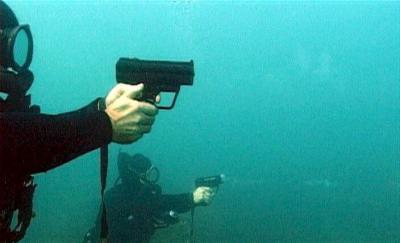
These guys seem perfectly fine to me
Posted: Fri Mar 13, 2009 8:25 am
by D_Hall
jackssmirkingrevenge wrote:These guys seem perfectly fine to me
Something tells me those aren't air guns.
Posted: Fri Mar 13, 2009 9:44 am
by Fnord
There is ZERO danger of a pneumatic cannon coming apart underewater. Or at least, the danger is no higher than it would be on dry land.
I think the recoil from a full barrel of water might run a risk of doing damage.
Not only to the cannon, but to
you.
(I've tried it with 24" of water in sdr 21. Hurts a bit:)
Posted: Fri Mar 13, 2009 10:51 am
by jackssmirkingrevenge
D_Hall wrote:Something tells me those aren't air guns.
Not quite
I think the recoil from a full barrel of water might run a risk of doing damage.
Not only to the cannon, but to you.
Ah, but if you fired it underwater...
Posted: Fri Mar 13, 2009 1:29 pm
by Fnord
Ah, but if you fired it underwater...
The recoil would be reduced compared to air, but I bet it would still be significant. There is water resistance as the gun moves, but I don't think it would be enough to keep a pvc joint from snapping that would normally snap in air.
Posted: Fri Mar 13, 2009 3:25 pm
by psycix
D_Hall wrote:psycix wrote:Nobody tried it yet. Or survived it....
On the contrary. The military does it on a very large scale every time they launch a missile from a submarine.
I understand that there are indeed some serious pressure waves thrown around in that scenario, however.
But the people in the sub are inside, and not holding the launcher in their hands. In other words: between the muzzle and their ears is not only water, but also air.
I am not worried about damage to the gun, but about damage to the person firing it. If 100 psi comes out of your barrel at a high volume, and the water effectively transfers this pressure wave onto your eardrums, wont that do some serious ear damage?