Ugh, the backspin issue.
Never thought I'd need to do this, but give me a minute, I'm going to have to program lift and backspin into the range calculator.
*Programs lift and backspin into the range calculator*
Sorry Starman, unless you're going vastly supersonic from the out, you're not getting a half mile range.
Heck, it's hard getting much over a quarter mile subsonically, even with some backspin to help out.
The problem is, lift is dependent on the projectile having velocity in order to create that lift. Like drag alone squashes a perfect parabolic arc, increasing curve towards the end of the arc (as velocity falls), the projectile's lift suffers too suffers the same problem.
As drag slows the projectile, velocity falls, as does lift. Although the lift may allow the projectile to rise towards the start of the shot, the loss of velocity lessens it's effect. (That's not even getting into the loss of backspin speed, although for now, I'm considering that negligible for the effort of modelling it.)
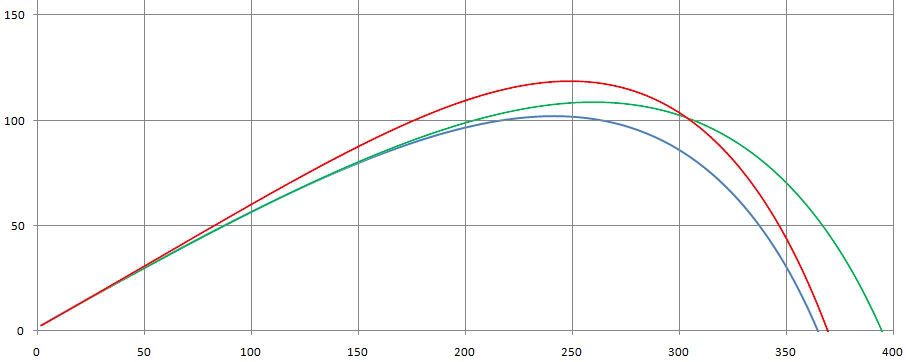
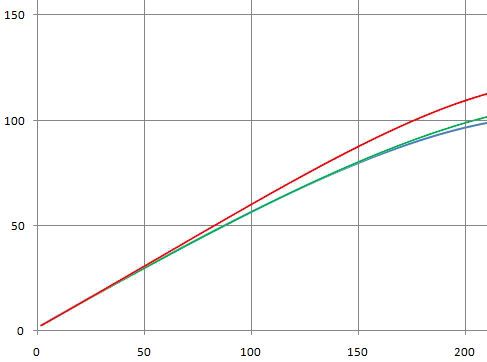
Also, too much lift can alter the projectile's arc inefficiently (look at the linked graphs below), because it's not generated downwards, but perpendicular to the trajectory.
Essentially, what I'm saying is that it might seem like the projectile is still rising at a quarter mile, but I suspect there's a disjoint between what you think is a quarter mile in the air and what really is a quarter mile.
Most likely, your golfballs are all hitting the ground within about 500 metres.
Now, I accept my modelling may not be perfect, and I don't know the exact specifics of your cannon but I think it's more likely that you're misjudging how far away the balls appear to be, given that I was trying to give you every advantage in the simulation.
As a general rule, it's best never to make any assumptions of a projectile that's shot out of sight for so many reasons.
I automatically disqualify range claims of the order you're making unless it's either a calculated estimate using a proper ballistic model, or exceptional circumstances are at work.
~~~~~
All that said, you do get some very interesting trajectories from adding lift. Because a projectile has to trade velocity for height, you get less lift at the apogee than lower down (and also because the air is slightly thinner up there, so less lift from it).
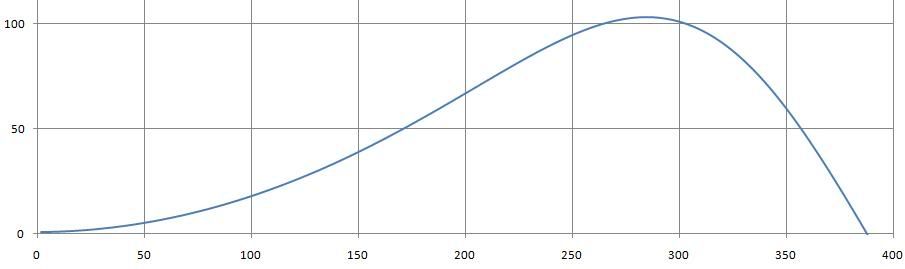
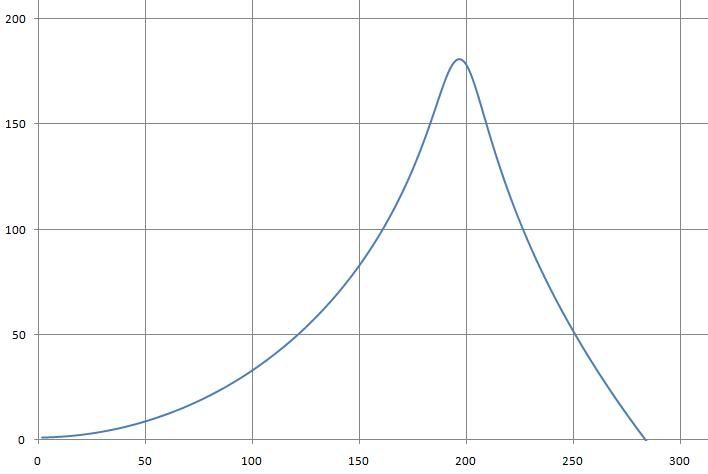
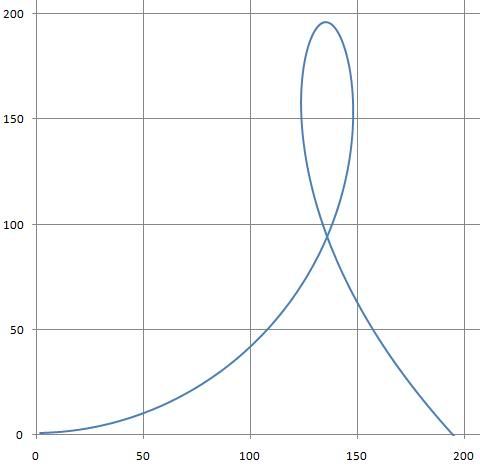
Modelling the same projectile with increasing (and deliberately ridiculous) lift:
1500% lift
2500% lift
3000% lift
Each of the percentages represents the relationship between the projectile's weight and the perpendicular lift at the muzzle velocity. That is, at 100% lift, and if fired level, at the muzzle, there is no net vertical force on the projectile.
These graphs show that more lift is not always beneficial to range, as they're all the same projectile at the same initial velocity - they're also all fired parallel to the ground!
And yes, before anyone asks, with enough lift, it is possible to get it to land behind you - or even on you, for which the magic number is about 6750% in this case.
 and I didn't claim to see the ball at 1/2 mile...did I..?..geeze...