D_Hall wrote:I'm wondering if your drag coefficient is off in your math.
I'm using a Cd of 0.30, which gets modified relative to Mach number. Mass is taken as 45 grams, diameter as 42.7mm.
Those are the most reliable figures I can find for golf-balls, including a few tests of my own that corroborate that.
Point being that you'd have to go a long way to convince me we weren't in the 500 meter range on shots wherein we elevated the barrel
Well, here's some interesting pictures for you.
Here we can see the first 200 metres of the trajectory of a normal golf-ball (Blue), a golf-ball with backspin (Red), and a golf-ball with a 10% reduction in drag (Green) - all have a 200 m/s muzzle velocity, and IIRC, a 35 degree launch angle.
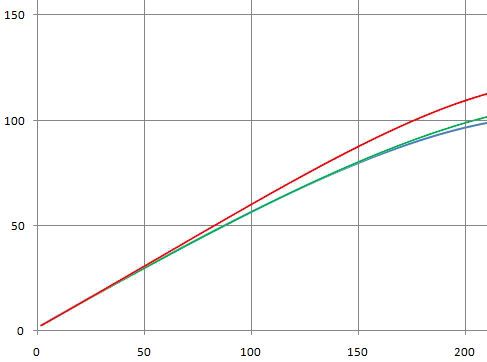
Based on how much of that you can see, it looks like those balls could fly over 500 metres.
Now we'll complete that graph with the rest of the trajectories:
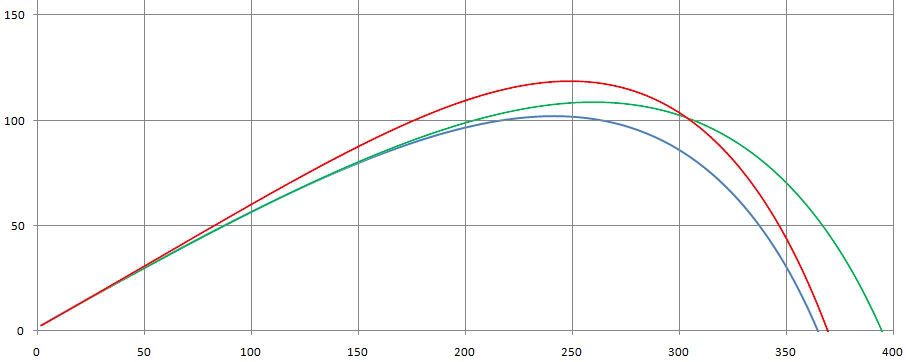
... not one makes it to 400 metres. It's hard for the human eye to make out the range and velocity of a fast moving small object that's soaring through the sky, and it's very easy to make mistakes extrapolating, particularly where poor ballistic coefficients are involved.
As a result, I'd generally sooner trust a simulated range - even if it was calculated with rough figures - than a guessed one.
Of course, if you should ever happen to find a golf-ball that far out (assuming still conditions), then I'll take apart the calculations to find where they went wrong - but I'm pretty confident that you won't ever find a golf-ball that far out. Based on your muzzle velocity, I'd expect a range of up to about 350 metres in still air.
ramses wrote:Rag is working with his own proprietary tool that hasn't been released yet.
Sure am. Currently, it takes about the current list into account: Drag and how it changes with Mach number, Lift, Atmospheric conditions and how altitude changes them, Wind, Latitude, Coriolis effect, Earth curvature, Basic projectile stability - and possibly one or two other things I've forgotten to mention. (Although, in this case, I wasn't calculating anything from wind onwards).
Provided you've given it the right numbers, its results are about as reliable and accurate as you could sensibly hope for - as D_Hall explains above, drag coefficients are not an exact science even at the best of times.
But, even accepting that no simulation can be perfect, that doesn't stop the LRC having the edge over the GGDT tool - in this case, the LRC's more sophisticated transonic and supersonic modelling is very relevant.
Spheres have a very wide transonic range, from about Mach 0.5 to Mach 1.5 - with a perfect sphere, D_Hall's 600 fps WOULD be marginally transonic. Golfballs are slightly less egregious as far as that goes, with a transonic range of about Mach 0.6 to Mach 1.3, but that's still a major consideration.
I would recommend you go to the wiki and use the very old version of LRC (the spreadsheet), as it was actually designed to compute range.
The old version of the LRC has an inherent flaw in the way it calculates drag that can cause errors in the predicted range. Take its outputs with a pinch of salt.
How's that going?
It's been on hold for some time now, because I'm busy.
... okay, I'm also lazy.