Page 3 of 6
Posted: Tue Jan 25, 2011 7:03 am
by jackssmirkingrevenge
Nice shot! I see what you did there

So... would I have such an issue with the aforementioned ignitors supplied by our benevolent sponsors?
Posted: Tue Jan 25, 2011 7:52 am
by Hotwired
Nope. They put out a spark exactly like a piezo, low current, high voltage. You'll be disappointed if you expect a spark of higher voltage than a piezo. Higher current probably but voltage, no.
Incidentally, a flash capacitor holds about a thousand times more energy than the ones discharged to create each spark in stun guns and igniters, it's massive overkill and corrodes electrodes much more because of that.
Posted: Tue Jan 25, 2011 8:08 am
by Insomniac
Not to mention epic battery drain!
Posted: Tue Jan 25, 2011 8:15 am
by jackssmirkingrevenge
Hotwired wrote:You'll be disappointed if you expect a spark of higher voltage than a piezo. Higher current probably but voltage, no.
The situation is that basically, using cigarette lighter piezos which are probably the lowest rung in the spark ignition ladder, and using as small a spark gap as I can manage (basically the width of a paper) I'm stuck at 16x maximum reliable ignition, occasionally 17x. All I'm looking for is something that will reliably ignite the maximum mix possible with a propane/butane mix at atmospheric pressure, which means around 28x at around 400 psi.
Do you think the USG type ignitor will serve this purpose?
Posted: Tue Jan 25, 2011 9:20 am
by jrrdw
I recently stripped a old power supply out of a computer and last night built the circuit described
here. I didn't have the proper transistor so it only worked for about 3 seconds. I used a 2N2222 that I have from a old kit. I used one of the inducers off of the power supply,
part#:
DT-E16-114A
DET0137(0)
0915
I got 68.4 VDC out of a 9V battery!

My resisters where to high in value but I'm/was thinking that's better then under valued. I didn't put a switch in, just wanted a pumped up voltage and success I got it.
@JSR, everything to make that fly back work is on that PCB and then some or the monitor would have not worked for it's intended purpose, (my Einstein moment in sentence)

.
Some pics.


Posted: Tue Jan 25, 2011 11:25 am
by Hotwired
The funny thing about those circuits even though some of those pages authors have the idea they were original inventors...
...is that the basic transistor, transformer, resistor circuit is what is in disposable flash cameras bumping up your little AA or AAA battery to the 350V to charge a fat electrolytic capacitor for the flash.
This is all you need to have:

Only one resistor needed you may note. Also only 5 pins on the transistor instead of the six that are used in the webpage articles. That's because inside this transformer two of the coils are sharing one terminal. It still functions the same way.
But the stripped down circuit shown is just a transformer, 220ohm resistor and a NPN transistor.
The diode is there because the output comes off as AC and needs rectifying to DC to charge a capacitor.
After some hacking of a related diagram, here is the diagram of the basic flyback circuit as photoed above:

Posted: Tue Jan 25, 2011 12:23 pm
by jackssmirkingrevenge
jrrdw wrote:everything to make that fly back work is on that PCB and then some or the monitor would have not worked for it's intended purpose, (my Einstein moment in sentence)
I guess that makes sense, except I don't want to use it for its intended purpose
Ok boffins, LET'S GET THIS SORTED!
Posted: Tue Jan 25, 2011 12:24 pm
by Technician1002
Is this a good time to point out the band on the diode is the Cathode? The output polarity is backward.
As far as the 3 leggged beasts go, the two on the left side are dual diodes.. 2 diodes in a package with the Cathodes tied together.
The C5027 is a Fairchild brand bipolar transistor. You can look up the transistor pinout and specifications by using the full number which is 2SC5027. Do a Google search. From left to right with the leads down, the pinout is Base, Collector, Emitter.
http://pdf1.alldatasheet.com/datasheet- ... C5027.html
The number is part of the Japanese semiconductor numbering system. The 2 is the number of leads -1 so a 2 is a 3 leg device. A 2SA is a high frequency and 2SB is a low frequency PNP bipolar transistor. A 2SC is a high frequency and a 2SD is a low frequency NPN transistor. 2SJ and 2SK are N channel and P channel FET's.
2SA and 2SC devices tend to be RF devices and 2SB and 2SD devices tend to be audio, power supply or switching transistors.
The two lower right ones I can't read the number. The two with the E number, I'm not sure. I'd have to look those up. I think they are either an IC or MOSFET.
Posted: Tue Jan 25, 2011 12:30 pm
by POLAND_SPUD
Is this a good time to point out the band on the diode is the Cathode? The output polarity is backward.
Could you translate it into English ?

Posted: Tue Jan 25, 2011 12:38 pm
by Technician1002
Yes, the band or white stripe on the end of the diode is the + end. The wire marked with a + is the - end.
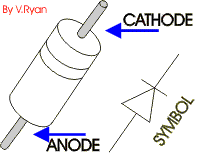
Here is how the physical marks correspond to the schematic symbol.
Posted: Tue Jan 25, 2011 12:42 pm
by Hotwired
The output polarity is correct.
Photo was taken 5 years ago when I was fiddling with flash circuits more, I'm pretty sure that one worked.
Not 100% on which way round that diode should be now, photo is 5 years old and I don't have a bare circuit any more.
I'll get back to you in a sec.
Holy crap, just found the actual original physical circuit. Going to have dinner and recheck components.
Nvm, found a better circuit. Yes the diode is the wrong way round. Output polarity marks are correct, diode polarity is not.
That would possibly be why I still have the original circuit loose and not used in something....
Posted: Tue Jan 25, 2011 1:19 pm
by Technician1002
I didn't answer one of your original questions on the computer power supply. The diodes near the AC input are high voltage devices.. May be useful for charging a high voltage flash cap. The Power transistors driving the transformer is a high speed, high voltage, switching transistors. I'm sure you may be able to find a use for that.
Posted: Tue Jan 25, 2011 1:34 pm
by Hotwired
Circuit photo and diagram should now be correct

Posted: Tue Jan 25, 2011 1:40 pm
by jackssmirkingrevenge
I'm getting somewhere... one last bit of help, what colour codes are a 22 ohm and 220 ohm resistor?
I'm trying to put this together with the C5027 transistor:

Posted: Tue Jan 25, 2011 1:46 pm
by Hotwired
Top right two:
http://html.alldatasheet.com/html-pdf/1 ... TF3-T.html
Middle left:
http://html.alldatasheet.com/html-pdf/1 ... 508DF.html
Middle right:
http://html.alldatasheet.com/html-pdf/1 ... 527AX.html
And dammed if I can read the bottom right one. Or maybe I can and the markings actually are unhelpful.
I'm pretty sure that's a 220ohm in my photo but anyway, should be red-red-black-black plus one or two extra colour stripes for tolerance and temp coefficient.
22ohm would be red-red-black plus a stripe for tolerance
