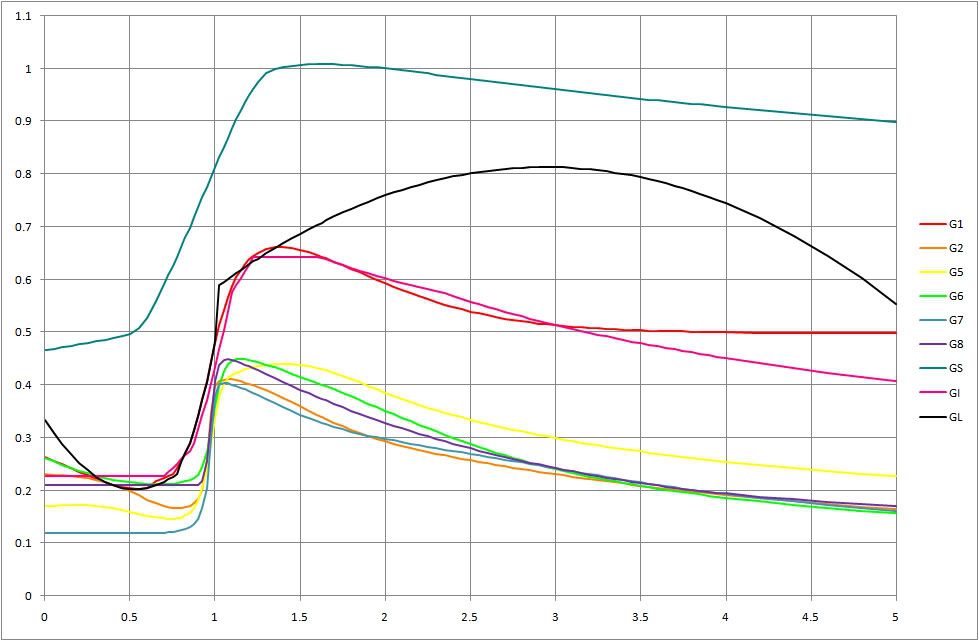
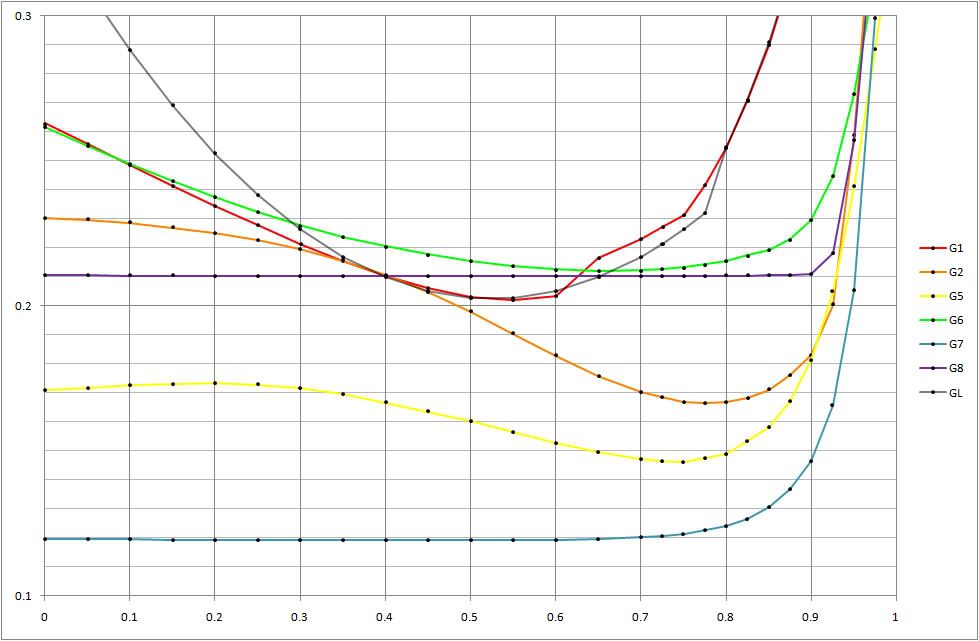
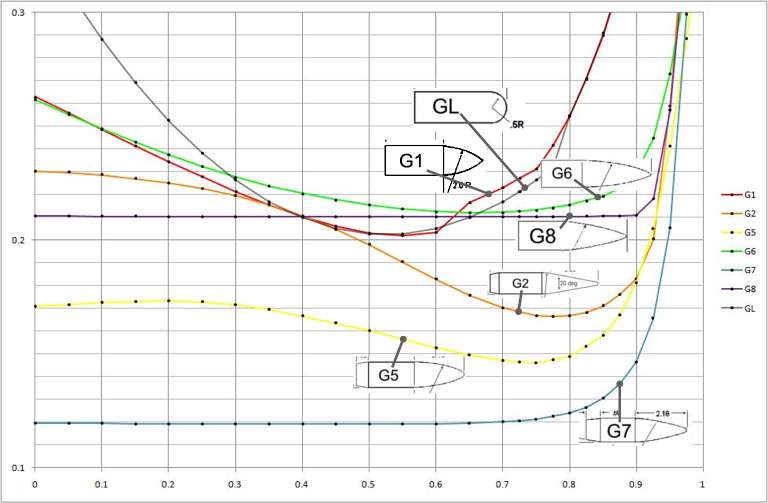
jimmy101 wrote:At typical spudgun velocities of say 300 - 700 FPS, the GL nose (a hemisphere) is as good as or better than the three pointier tips.
GL is a good shape in that range, yes, but other things have to be taken into consideration. Like you said:
The major significant factor is friction drag, which is largely dependent upon the wetted area, the surface smoothness of that area, and the presence of any discontinuities in the shape.
The brute force of the nose produces a relative vacuum around the projectile, reducing friction drag. This vacuum also reduces tail eddies (like a boat tail).
It should be noted that these traits are highly dependent on the round's length. Using a blunt nose on a longer round would show less beneficial traits with regards tail eddies, and on a shorter round with regards friction drag. As such, GL's success is a bit like the
Ballmer peak, it's very dependent on a specific variable being in the right range.
This is also why the GL shape has a very specific velocity range in which it fairs well. It's poor Cd at lower and higher velocities is when the advantages conferred by these traits start to die down - as can be seen by comparing it to the similar, but pointier noses G1 (which I feel better represents the 747 if I'm honest) - which shows performance within 3% of GL essentially between Mach 0.3 and Mach 1 - but a very drastic improvement below that range, which we have to consider that lobbed spudgun shots are likely to fall into, mostly due to velocity traded for height.
Simulating a 150 m/s 100 gram projectile of 1.5" diameter being launched at 35 degrees (usually roughly the "ideal launch" angle when drag is applied) and applying the
exact drag characteristics of all the blunt tailed rounds (assuming stable flight), with all else the same.
Full drag integration active, 1 ms timebase, altitude air density variation, 1013 mb, 20 C, 60% RH and no wind.
G1 - Minimum flight speed: 51.6 m/s - Range: 759 m.
G6 - Min flight speed: 51.2 m/s - Range: 747 m.
G8 - Min flight speed: 53.9 m/s - Range: 786 m.
GL - Min flight speed: 49.8 m/s - Range: 741 m.
(The numbers may seem high to some people, but consider the cannon is pretty powerful, and these results are assuming stable projectiles, which most spudgun shots aren't)
There's clearly no huge amount in these figures, but it demonstrates how low a projectile's speed can fall. Now, clearly, at those low velocities, drag is much reduced, but notice the advantage of G8, which flies around 3% further than the other rounds.
That low drag at lower velocities really benefits it.
Now, for fun let's simulate GC, the 3 diameter cylinder... Min flight speed: 33.7 m/s - Range: 402 m.
Ouch. That shows what a really blunt nose does for you.
~~~~~
Now, back to the friction vs. pressure drag, what I would be interested to see however is how all those shapes faired if the friction drag were reduced - i.e. the rounds were all polished smooth and perhaps coated. (I'm currently experimenting with Teflon coating materials.)
~~~~~
@Jitup: There is no such software that analyses video feeds. If you really want to find the sort of data we're throwing around at the moment for a certain projectile, expect to pay around $250,000 for the radar based equipment.
I spent some time finding the data we're using at the moment on the internet. It's information the firearms community uses regularly, and it relates to very specific shapes. It's possible to use the data here for predicting how similar shapes will act, but it's still a bit imprecise.