GonzoInferno wrote:JSR - Do you have any mental reference to pneumatics reaching anywhere near mobile chernobyl's 1500fps + averages.
The
Airforce Condor does just over the speed of sound using HPA and a high flow valve, as do some other high end commercial rifles, but 1,400 or so fps seems to be the practical limit with air. If you want to go higher without going hybrid, you have to use a light gas like helium or hydrogen as your gas source.
How much influence does kinetic energy have to do with FPS velocities? I mean two spherical projectiles, one ping-pong ball, the other golf ball will have different results.
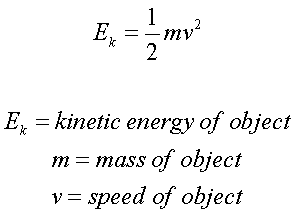
Double the mass, get double the kinetic energy. Double the velocity, and you quadruple kinetic energy. Heck if you move water fast enough it will cut through steel.
The projectile is of course important too. As anti-tank kinetic rounds represent the epitome of high performance rounds, tet's take an advanced projectile as an example:
[youtube]
[/youtube]
In order to achieve optimal penetration and range, the following parameters are important:
1) high velocity - if a projectile travels slowly, the target will have time to deform and absorb the blow without penetration, and therefore in order to penetrate well you need as high a velocity as possible. A typical anti-tank round is travelling at around 5,000 fps.
2) high sectional density - in order to maintain its momentum, and transfer the energy in a concentrated manner, you need a projectile that is as heavy and narrow as possible - this is why APFSDS rounds are made of very dense materials such as tungsten or depleted uranium, which being long and thin to give the distinctive arrow shape. This attribute also makes it very efficient flying through the air, remember that essentially what the prokectile is doing is "penetrating the air", so what makes it good to go through a target also makes it good to fly far.
You can see this with the golf ball/ping pong ball analogy, both have the same frontal area but the golf ball has higher sectional density so if you fire them off at the same velocity, it will slow down less quickly and therefore fly further.
3) high projectile hardness - nature will always choose the path of least resistance, so if the target material is tougher than the projectile, the impact energy will go towards shattering or deforming the projectile as opposed to the target.
4) optimal aerodynamic shape - this is especially important for high velocity projectiles:
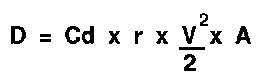
As you can see, drag has a similar relationship to velocity as kinetic energy, so if you double projectile energy, it has to fight four times the drag.
The shape of the projectile dramatically influences drag, namely through the C<sub>D</sub> or drag coefficient:

It's clear that for the same velocity, weight and frontal area, a sphere would be subject to over 10 times more drag than an airfoil shape. This is why spheres are pretty terrible projectiles when it comes to retaining energy.
And, oh yeah, APFSDS style rounds MUST be attempted.
Note that using a sabot gives the best of both worlds - light weight and large frontal area inside the barrel, to give you optimal acceleration and high velocity, yet once the sabot is discarded, the subprojectile itself has high weight relative to its tiny frontal area, which makes it ideal for punching through the air and eventually the target.
The epitome of a "hybrid", the Utron 45mm CLGG certainly proves that there is a stage at which recoil absorption becomes necessary
A certain Mr. Hall might object to that assessment of Utron's puny efforts


 as well as the fact that what they are doing can actually eventually be a viable weapons system.
 they also have a caravan camper - and being such a fan of Top Gear that I am - you can only imagine what I would do to that thing lol.