Page 1 of 2
painful video
Posted: Sun Dec 16, 2007 11:10 am
by Solar
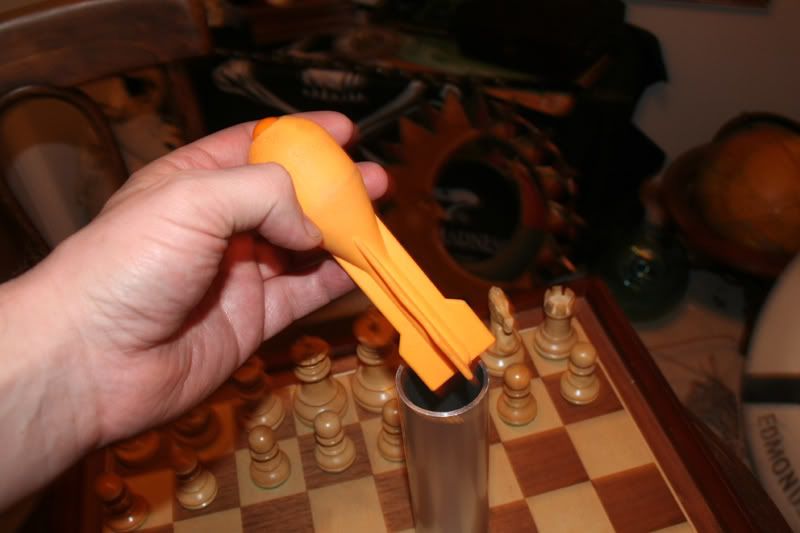
Above is the projectile. Video shows 23 gram rocket launched from 150 feet at 600 fps.

Posted: Sun Dec 16, 2007 11:17 am
by Hubb
Assuming this is your revolving launcher that is used? It sounded bad.
Posted: Sun Dec 16, 2007 11:43 am
by Hotwired
From where I spotted the orange blur heading it looks like a headshot

Half expected the screen to slowly fade out and the breathing to stop at the end

Sounds a bit too painful for games at that speed, better do some more testing to find a pressure/volume (can't remember which you said you changed) that doesn't get you groaning on the ground.
Posted: Sun Dec 16, 2007 12:19 pm
by Antonio
I dont think this is that bad. The muzzle velocity may be very high, but due to drag the projectile will slow down ALLOT. I did this calculation and over a 90 feet range the projectile will only go at around 72ft/s. As this test was done on a bigger range it must not have been that killing''.
Posted: Mon Dec 17, 2007 1:45 am
by jackssmirkingrevenge
23 grams at 600 feet per second means 284 foot pounds or 386 joules of muzzle energy. The minimum NATO standard for a projectile to produce a lethal wound is 85 joules. You might want to turn it down a bit

Posted: Mon Dec 17, 2007 2:56 am
by Antonio
jackssmirkingrevenge wrote:23 grams at 600 feet per second means 284 foot pounds or 386 joules of muzzle energy. The minimum NATO standard for a projectile to produce a lethal wound is 85 joules. You might want to turn it down a bit
Plz just listen up, I know the muzzle energy is really high. But these ppl shot this at 150feet. At this distance most of its energy has been disipated into drag. Only about about 1/10 of the engergy would be left over this range. So yeah it is deadly'', but I am saying its not that bad over the distance that was shown on the vid.
Posted: Mon Dec 17, 2007 3:05 am
by jackssmirkingrevenge
150 feet doesn't sound like sufficient distance for a streamlined and reasonably heavy projectile to lose so much velocity, I would suggest shooting at plywood/cardboard sheets before trying it out on people.
Posted: Mon Dec 17, 2007 4:22 am
by Antonio
jackssmirkingrevenge wrote:150 feet doesn't sound like sufficient distance for a streamlined and reasonably heavy projectile to lose so much velocity, I would suggest shooting at plywood/cardboard sheets before trying it out on people.
Yeah you never know how fast they really go. At this speed its not very responcible to shoot at ppl. Btw the way to calculate the decrease in speed over a distance is to use: Drag force=0.5*Cd*density air(1.225)*V^2*frontal area > F=m*a > a=F/m >where the force is the drag force. Btw the Cd(drag coefficient) for a sphere is about 0.5. Then if you intergrate this over the distance which it is shot at u can calculate the final velocity which will be about 1/8 of the original over a 30m for example. I have done these calcs on excel and its a kinda heavy document(6mb) bc I tried to approximate it as accurate as possible. I am telling u 150feet=50m> at that range drag is Really significant.
Posted: Mon Dec 17, 2007 5:44 am
by jackssmirkingrevenge
I understand the calculations involved but still, an 87.5% decrease in velocity for such a projectile over 30 metres seems far too much, consider that the long streamlined form is a lot more aerodynamic than a sphere.
Posted: Mon Dec 17, 2007 6:15 am
by Hotwired
The final say is not from spreadsheets but the guinea pigs that were used in firing tests
Posted: Mon Dec 17, 2007 5:09 pm
by Solar
The cameraman was actually the maker of the rockets. The velocity does decrease significantly, but it obviously still packs a punch. I would not ever use these velocities for paintball. This was a test for a request we had for a less lethal application. Our next tests(without humans) will be with rounds up to 62 grams. We would like to maintain somewhere between 200-300 fps at 150ft. At 350psi with the softer rounds we had two misfires that we are attributing to deformation of the round as it passed into the receiver from the revolving chamber. Hence the camera operator taking steps closer after the first two shots. I aimed in the high chest area and it contacted him just inches from the family jewels. (!) It bruised his leg immediately. He said that it was like getting hit with a giant wet towel and that if he was running for his life it probably wouldn't have stopped him, but he would certainly not advance towards the shooter. You guys seem to know your stuff when it comes to the math behind all this. I will gather some better data in the future to share. I based the 600 feet per second off of earlier chrono tests and the fact it took 8 frames of video to reach the target. each frame equal to 1/30 of a second.
Posted: Tue Dec 18, 2007 2:46 am
by Solar
I guess I could try my targeting skills and fire through two chronos, one at range. I also forgot to add the weight of the paintball when I claimed 23grams. These fire about 250 yards at 350psi (same pressure in video) with a forty five degree indirect fire. The terminal velocity seems quite low at that point, but the targets claimed that they couldn't see the hail of six rockets until they were landing around them.
More testing is certain. Thanks for the info.
Posted: Tue Dec 18, 2007 2:57 am
by jackssmirkingrevenge
I would certainly suggest using human analogs first before even attempting to shoot at live targets.
Posted: Tue Dec 18, 2007 3:11 am
by Solar
Yes. Lesson learned. Any ideas on a good way of doing this? What is the name of the equipment that can test impact energy on a target? Testing facilities somewhere have these for this very purpose.
Posted: Tue Dec 18, 2007 3:24 am
by jackssmirkingrevenge
This will still involve a bit of pain, but after all, we're men

I think the easiest way to check this for a given projectile would be to start off at low velocity then gradually increase power until you determine that the power is just about tolerable for a human target. See how many sheets of thick cardboard the round will penetrate at this velocity and do your subsequent tests with the cardboard as a target. Since you can get it in large sheets, it will be an easy target to hit at long distance to see how energy varies with range.