Solenoid Piston Valve
Posted: Thu Dec 27, 2007 3:13 pm
I hope this hasn't been suggested...
I thought it'd be cool to use a solenoid to activate a piston. It would allow you to fill from anywhere, and it would eliminate piloting completely! Also, it's my (probably flawed) understanding that it would activate really fast!
Here's a poorly drawn diagram:
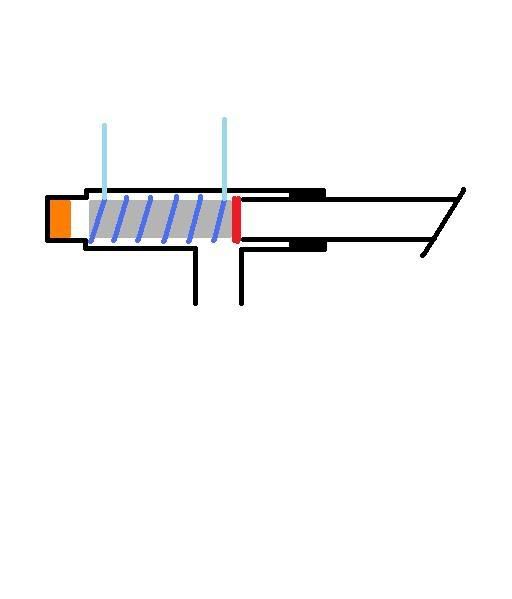
Since I cant figure out Paint on Vista, I'll tell you what each color means.
Black: Pipe and other crap
Silver: Piece of iron or steel pipe
Red: Sealing face
Purple: Spring with a "k" just big enough to hold the piston sealed at 0 psig. Fairly thick wire, but low spring constant. Also inductive, such as copper. Is connected to the piston at one spot near the barrel, but the copper is more conductive. (hard to describe)
Blue: Wires to power source, probably a car battery. (100 - 200 amps)
Orange: STRONG bumper
The piston is as short as you want it to be, but the spring must still have a certain number of "turns" so that the solenoid still works. It doesn't need to move back FAR, but the whole point of this is to get it to move FAST.
The outer pipe is big enough to hold the spring, then reduces to the point where the spring is held, but the piston can move back. The spring is initially slightly compressed, and when the solenoid is activated, is even more compressed, so that the piston reseats after the current stops flowing.
The only problems I can think of are those I can't diagnose, i.e. I don't know much about electronics, or magnetic fields. I have a general idea of the concepts, but I'd need someone to crunch some numbers. Feel free to change any quantity to fit your needs.
Feedback and help are both appreciated!
I thought it'd be cool to use a solenoid to activate a piston. It would allow you to fill from anywhere, and it would eliminate piloting completely! Also, it's my (probably flawed) understanding that it would activate really fast!
Here's a poorly drawn diagram:
Since I cant figure out Paint on Vista, I'll tell you what each color means.
Black: Pipe and other crap
Silver: Piece of iron or steel pipe
Red: Sealing face
Purple: Spring with a "k" just big enough to hold the piston sealed at 0 psig. Fairly thick wire, but low spring constant. Also inductive, such as copper. Is connected to the piston at one spot near the barrel, but the copper is more conductive. (hard to describe)
Blue: Wires to power source, probably a car battery. (100 - 200 amps)
Orange: STRONG bumper
The piston is as short as you want it to be, but the spring must still have a certain number of "turns" so that the solenoid still works. It doesn't need to move back FAR, but the whole point of this is to get it to move FAST.
The outer pipe is big enough to hold the spring, then reduces to the point where the spring is held, but the piston can move back. The spring is initially slightly compressed, and when the solenoid is activated, is even more compressed, so that the piston reseats after the current stops flowing.
The only problems I can think of are those I can't diagnose, i.e. I don't know much about electronics, or magnetic fields. I have a general idea of the concepts, but I'd need someone to crunch some numbers. Feel free to change any quantity to fit your needs.
Feedback and help are both appreciated!
