I've built the model for the cited data. Only four of the parameters are needed. The param's along with their contribution to the model are;
<table><tr><td>Parameter</td><td>incremental R^2</td><td>total R^2</td></tr><tr><td>Pressure</td><td>0.648</td><td>0.648</td></tr><tr><td>Air Vol.</td><td>0.229</td><td>0.877</td></tr><tr><td>Angle</td><td>0.0674</td><td>0.945</td></tr><tr><td>Wadding</td><td>0.0414</td><td>0.986</td></tr></table>
The R^2 values indicate how much of the spread in the distance the projectile flew is explained by the particular parameter (incremental R^2) and how much is explained by the parameter and the ones before it (total R^2).
So, pressure is the largest affect and accounts for 65% of the spread in the distances. Air volume is the second largest affect and accounts for 23% of the spread. These two parameters together account for 88% (total R^2) of the spread in the data. Launch angle is the next most important, it picks up another ~7% for a total accounting of ~95% of the data. The last parameter, the wadding, picks up a bit more but is probably down at the level of noise. With all four of the parameters 98.6% of the data is explained by the four parameters.
The model's equation that predictes the distance is;
Distance = (10.349)(Pressure) + (0.259)(Air Vol.) + (-4.444)(Angle) + (52.22)(Wadding) - 40.15
where;
Pressure in PSIG
Air Vol. in cubic inches
Angle in degrees (0deg = horizontal ?)
Wadding 1=paper, 2=cloth (non-parametric)
A graph of the predicted distance versus the actual distances is below;
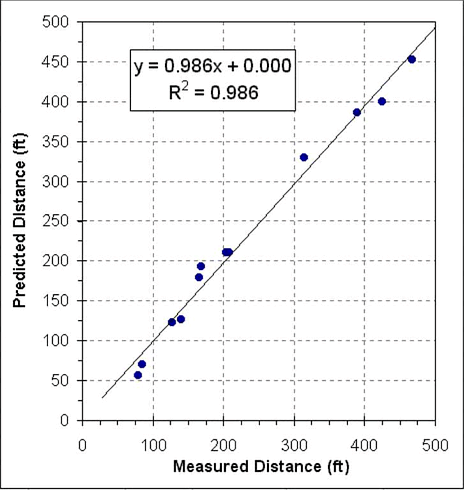
As you can see, the model almost perfectly predicts the behavior of the cannons.
Unfortunately, the model is of no practical use for predicting the performance of guns that differ from the guns used to generate the data. This includes the inability to correctly model the affect of launch angles that are outside the 45 to 60 degree range. The model won't even correctly handle launch angles outside the 45-60 range for the same cannons.
This whole approach depends on a linear, or nearly so, relationship between the parameters and the measured performance (distance in this case). Unfortunately, none of the parameters are actually related to distance in a linear way.
The air volume and pressure parameters are related to the distance as asymptotes. That is, at low volume or pressure ranges the distance changes roughly linearly with these two parameters. However, at high values of volume or pressure the distance will approach a limiting value asymptotically.
The barrel length and launch angle are also not related to the distance in a linear way. Both of these parameters have an optimal value. The gun's performance drops off when these parameters are higher
or lower than the optimal value. A plot of distance versus either launch angle or barrel length gives a graph with a hump in it.
The optimal launch angle for a golf ball is probably in the vicinity of 35 degrees. Launch angles greater or less than ~35 degrees will give decreased distances. This type of model can not handle a variable of this type. As far as the model is concerned, shorter barrels and decreasing launch angles always increase the performance of the gun.
It is too bad that so few of the relationships in spudguns are linear. The Tauchi method is amazingly powerful at reducing the number of measurements that need to be done. In this particular study with 2 values for each of 8 gun parameters there are a total of 256 possible configurations. If each configuration is fired four times (to get averages) you would have to do a total of 1024 firings to collect the data. The cited study did almost the same thing with just 48 firings.
In order to use this type of a model a way is needed to convert the non-linear responses into linear ones. In general, that type of conversion means you have to add variables to the system. For example, the optimal launch angle might be expressed in the Taguchi matrix as;
1/|angle<sub>optimal</sub> - angle<sub>actual</sub>|
For the angle column you would then need to calculate both the columns coefficient and the value of angle<sub>optimal</sub>.
Does anyone have any thoughts on how to linearize the variables? In particular, launch angle, pressure, chamber volume and barrel length.
I would think that people have run into this type of problem before. Whether they are using the Taguchi approach or some other method of reducing the number of experiments (measurments) required to determine a model.
Edit: 2^8 is 256 not 1024 (well duh)


