Page 1 of 1
Glue/solderless Pump check valve
Posted: Mon Feb 25, 2008 12:05 am
by Mitchza89
I was in my shed looking to make a check valve for my new pump but I was out of money for new parts and I was just too damn lazy to go out and get some even if I did have the cash.
I just used what I had and could find in the shed. The main nipple is 3/4in compression into a 1/2in BSP thread, this is what gave me the base for the o-ring to sit and seal the washer. This valve could not be anymore simpler but I'll let you guys be the judge

.
Posted: Mon Feb 25, 2008 1:59 am
by Gippeto
Looks like it should work.
I do like the "serviceable" aspect. How much pressure are you looking for?
Proof that there is more than one way to remove a cat from his hide.

Posted: Mon Feb 25, 2008 2:50 am
by jackssmirkingrevenge
Have you guys ever thought of using a schrader as a check valve?
Posted: Mon Feb 25, 2008 3:16 am
by Mitchza89
That would work well. At the peak of compression, the piston head hits the valve pin and the air is let in. pull the plunger back, the air stays.
Gippedo, I'm looking to hold 300psi with it.
10min later...

I'M NEVER GOD DAMN MAKING ANYTHING GUN RELATED AGAIN..... I just got some 3/4'' pipe. It's the imported sh!t which has a smaller ID due to thicker walls so no o-ring I tried fitted....what a f##king waste of money...
Posted: Mon Feb 25, 2008 3:39 am
by jackssmirkingrevenge
Mitchza89 wrote:That would work well. At the peak of compression, the piston head hits the valve pin and the air is let in.
There's no need for the piston head to physically contact the schrader pin, it will allow air in by the pressure difference alone.
no o-ring I tried fitted
Go to a hardware store with the pipe you need to fit it in, they usually carry a wide selection of sizes and you're bound to find one that fits.
Posted: Mon Feb 25, 2008 4:01 am
by Mitchza89
no o-ring I tried fitted
Go to a hardware store with the pipe you need to fit it in, they usually carry a wide selection of sizes and you're bound to find one that fits.[/quote]
Yeah thats where I tried...Every size there but not one that fitted...

Posted: Mon Feb 25, 2008 5:12 am
by jackssmirkingrevenge
You could always do it the old fashioned way and use leather washers soaked in oil, Girandoni style

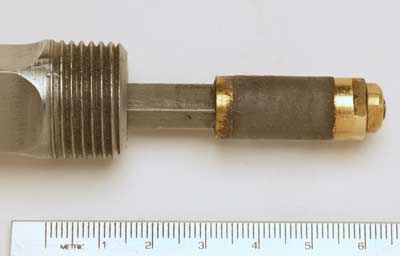
Head of the air pump from authentic museum copy of the Girandoni Military Air Rifle made from the above diagram. Two especially clever design features are shown here. First, note that the plunger, surrounded by several leather seal rings, can come right to the end to the pump, thus eliminating virtually all dead air space - an arrangement necessary to produce very high pressure in the gun's air reservoir. Second, note that the plunger head with its seal rings can be projected out of the pump body (as shown above) so that sealing oil may be applied directly to the leather seals. The seals may then be pulled into the pump body (as shown below) and a wrench applied to the lock nut- to precisely expand the seals to just the right seal and friction.
Posted: Mon Feb 25, 2008 5:37 am
by Mitchza89
I'm thinking that that piston head uses a couple of check valves?
Posted: Mon Feb 25, 2008 5:53 am
by jackssmirkingrevenge
No check valves at all in the pump, it has a hole at the top of the piston cylinder, as indicated by the blue arrows:
Posted: Mon Feb 25, 2008 2:31 pm
by Gippeto
jackssmirkingrevenge wrote:Have you guys ever thought of using a schrader as a check valve?
It didn't cross my mind until you mentioned it. I did get curious, and epoxied one into a fitting to test the cracking pressure.
I'm not sure if all schraders use the same spring, but the one I tested still had not cracked by 110 psi. (yes, it's in the right way
)
You might not be getting the chamber pressure you thought you were with those.

Edit:
The results of this test were bugging me, so after making sure that the schrader does indeed open, I tested it 10 more times. For whatever reason, these last 10 tests had the schrader cracking consistently at 70psi.

Posted: Mon Feb 25, 2008 3:13 pm
by bluerussetboy
Presta valves work better than schraders as check valves in my experience. The don't have that spring to f*** with like the schrader. Occasionally the schrader has to be cleaned because something got stuck in between the spring and sealing face. Not really a fun thing to find out at 200+ psi. Then you have to take apart the pump to fix it. The first and only time I used one I didn't think about making the pump serviceable. Serviceability is mandatory on pumps.
Posted: Mon Feb 25, 2008 6:56 pm
by Mitchza89
This is some what of a silly question but I'm not all that familiar with Garindoni pumps. I'm thinking that when the plunger is pulled right back, it goes back past the hole in the top of the cylinder which allows it to refill. Then when the plunger is pushed down, the air tight washers force the air through the check valve.
I'm thinking that the hole in the top also allows for the plunger to be pulled back too, ya wouldn't be able to do so if the piston head is air tight as it's supposed to be.
Curious Jack, how come you've never made a pump mate? Surely 500+psi looks pretty good to you
.
Posted: Mon Feb 25, 2008 7:29 pm
by MaxuS the 2nd
I've taken schraders up to 220psi, I don't see the worry about them blowing out after 60psi. Unless of course, you're using an 'epoxied' one.
Posted: Mon Feb 25, 2008 7:49 pm
by Hawkeye
The check valve for the Girandoni is also the firing valve. It's basically an oversized schrader housed inside the air cylinder.
I like to incorporate my check valves into the gun body. The pump is then much simpler to make. Basically identical to the Girandoni pump but using a floating o-ring instead of the leather washers.
The Girandoni pump could still be extended without the little hole. The actual pump rod would have to be airtight to prevent that.
Posted: Tue Feb 26, 2008 12:09 am
by jackssmirkingrevenge
Mitchza89 wrote:Curious Jack, how come you've never made a pump mate? Surely 500+psi looks pretty good to you
.
I've never made a big high pressure launcher, so far a shock pump has sufficed for my relatively tiny chamber volumes.