Page 1 of 1
before i build.
Posted: Mon Jun 30, 2008 4:39 pm
by vovka351
I've built a couple of pneumatics so far, they had ball valves shot about 600 feet. so i have *some* expierience.
I want to improve on these.
I plan on having a 2"x5' barrel and a 4"x2.5' chamber(or equivalent of 3" if i can't get 4" pressure rated)
the goal is to have a 2" piston valve. probably chamber sealing.
should be powerful...

I am looking for a material to make the piston out of, and a way to make interchangable barrels- between a 2" and a 2.5" for tennis balls.
suggestions?
Posted: Mon Jun 30, 2008 4:55 pm
by hi
you can take two 1 1/4'' end caps and glue them together and either use an O ring or simply wrap it with duct tape to make it fit in the 2'' tee. just be sure it fits well and you have a good bumper.
Posted: Mon Jun 30, 2008 5:02 pm
by daberno123
For interchangeble barrels between 2" and 2.5" all you have to do is put a 2" male adapter to thread into your piston valve. You'll have to reduce the 2.5" barrel down to 2", but the reduction in flow won't be that noticeable.
Also since this is your first piston valve (I assume?), try a barrel sealer, they are much easier to make.
Posted: Mon Jun 30, 2008 5:10 pm
by vovka351
so what is a good bumper? spring? foam camping mat(have too many of those around)?
yes- its my first piston, i don't see how to get the air on the ummm... non-pilot(?) side of the piston. plus, the area that the pressure is applied to is so much smaller, doesn't this lead to slower opening times?
Posted: Mon Jun 30, 2008 5:31 pm
by Pilgrimman
A good bumper would be 1/2 a tennis ball, or anything that will absorb a strong impact.
The air will leak to the chamber end of the piston unless you use O-rings (This is what you want) If you use O-rings, you will have to drill a small hole in the piston to allow air to flow to the chamber.
The area the pressure is applied to when firing the piston is small, but it is the ONLY area of the piston that has pressure on it when firing, so it will still open quickly, regardless of the area on the pilot side. The fact that the pilot side of the piston has more area exposed to pressure is what keeps the piston closed.
Posted: Tue Jul 01, 2008 11:13 am
by vovka351
well, here's my question:
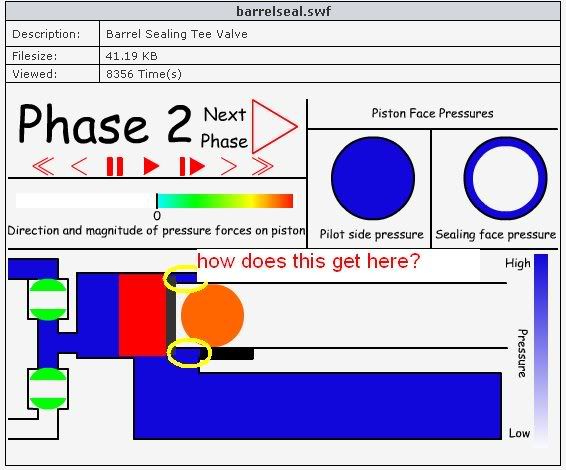
what causes air to get over there? I don't see how the shape with a void there is formed.
Usually, when you stick a piece of pipe into a tee, there is no such protrusion of the barrel into the chamber.
Posted: Tue Jul 01, 2008 11:31 am
by SpudUke5
Since there is no O-ring to create a perfect seal, the air seeps through the small crack and therefore air gets into to chamber and that little area.
Posted: Tue Jul 01, 2008 11:33 am
by starman
While the piston should fit very closely, it shouldn't actually seal the chamber. It also should move easily not catching in the piston cylinder. That's how air will leak around and behind the piston to provide the pilot pressure/depressure action.
Only the barrel should be perfectly sealed with the piston face.
Posted: Tue Jul 01, 2008 11:49 am
by vovka351
Should i use a special material for the sealing piston face?
as in: is that car inner tube (multiple layers?) i have lying around going to work between 80- 150 psi?
yes i am asking questions about everything--sorry, but i need to know before i build, and the wiki wasn't *that* helpful. i suck at forum surfing as well....
Posted: Tue Jul 01, 2008 11:53 am
by starman
vovka351 wrote:Should i use a special material for the piston face?
1/8" neoprene rubber is ideal...part number 9013K272 at
Mcmaster
Some people successfully use bicycle tire rubber.
Posted: Tue Jul 01, 2008 12:33 pm
by vovka351
I am not ordering off the internet, i am making this from stuff i can get at ace hardware. why? cuz its 100 fscking feet from my house.