Page 1 of 2
Help with toolie piston
Posted: Tue Apr 24, 2012 3:28 am
by grumpyoldman
Hey everybody.
I'm trying to build my first piston valve and I'm having a bit of trouble.
The piston is a piece of 1 1/2" pvc filled with glue using a glue gun. The chamber is 2" schedule 80 with an I.D. of 1.939. The O.D. of the 1 1/2 inch schedule 40 piston is 1.90.
The piston slides easily but snugly inside the pipe so I don't think it is hanging up.
When I fill the tank (testing at 60 psi) everything is fine. No leaks on the sealing face but when I trigger the valve (using a blowgun) all the air escapes through the blowgun and the piston doesn't move at all.
Can anyone tell me what I'm doing wrong? It's probably something simple and I'll feel like an idiot. Thanks.
Re: Help with toolie piston
Posted: Tue Apr 24, 2012 3:43 am
by jackssmirkingrevenge
grumpyoldman wrote:The chamber is 2" schedule 80 with an I.D. of 1.939. The O.D. of the 1 1/2 inch schedule 40 piston is 1.90.
The piston slides easily but snugly inside the pipe so I don't think it is hanging up.
Not as snug as you think. The area of the gap is equivalent to a 0.33" diameter hole, which means that when you try to pilot it, more air can rush past the piston from the chamber into the pilot area than can escape through the blowgun.
American (brutal, less efficient) solution: bigger pilot valve
European (elegant, more efficient) solution: tighter piston

Posted: Tue Apr 24, 2012 3:54 am
by grumpyoldman
Thanks jack! I think I'll get a 2" port qev or a 2" sprinkler valve for the pilot valve. THAT should fix it!

Posted: Tue Apr 24, 2012 3:58 am
by jackssmirkingrevenge
I understand you might not have access to a lathe but if you have a drill press, I highly recommend this excellent tutorial by Tech:
http://www.spudfiles.com/forums/tutoria ... 21740.html
With a floating o-ring, you will be able to pilot it with a blowgun easily. A pilot valve should always be as high flow as possible, but if you're using it to make up for a deficient piston setup you won't be getting the most out of your system.
Posted: Tue Apr 24, 2012 4:04 am
by grumpyoldman
Hey jack. I have access to a lathe. My nephew has one. What is a good tolerance for O.D. of the piston to the chamber? Evidently it needs to be very close.
Posted: Tue Apr 24, 2012 4:37 am
by jackssmirkingrevenge
Excellent, then you're sorted

If you're not going to use o-rings, a good rule of thumb (almost literally) is to make it as tight as possible but still loose enough to be pushed with one finger without too much effort.
Another option is to shape the piston like a cup seal:
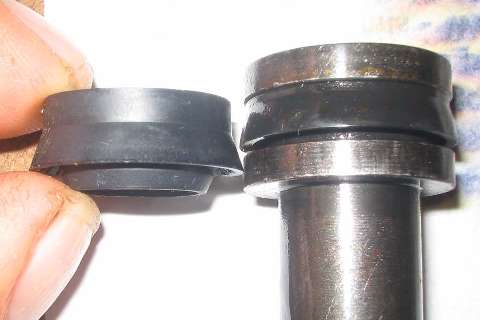
a floating o-ring is no big deal though.
Posted: Tue Apr 24, 2012 4:42 am
by grumpyoldman
Thanks a lot jack! I'll update when I've finished the new piston.
Posted: Tue Apr 24, 2012 11:18 am
by mattyzip77
try wrapping the piston with a layer of duck or electrical tape and a bigger pilot valve. You do not need a 2 inch qev or sprinkler valve. A 3/4 inch one will be just fine. If you are going to go that big with a 2 inch qev, then you dont even need the piston!!
Posted: Tue Apr 24, 2012 11:27 am
by warhead052
JSR, on the topic of floating O-rings, how effective are they in toolies valves? I wouldn't see how much more effective they would be compared to regular orings.
Grumpy, let me know when you solve the problem, I have been having the same problem as well, so let me know what you do to fix yours!
Posted: Tue Apr 24, 2012 11:42 am
by jackssmirkingrevenge
warhead052 wrote:JSR, on the topic of floating O-rings, how effective are they in toolies valves?
Coincidentally one of the projects on my desk is a toolies valve, and I an tell you that a floating o-ring can make the difference between a valve that works and valve that doesn't.
I wouldn't see how much more effective they would be compared to regular orings.
I don't see what you mean, a regular o-ring will seal the piston completely, meaning that if you're filling from the pilot side, the chamber will never fill, and if you fill from the chamber side it will never seal.
Posted: Tue Apr 24, 2012 12:01 pm
by warhead052
Then that partially explains the problem I have been having. Except with my toolies, it leaks out of the muzzle, which is weird, because it won't vent out the muzzle, just the pilot. And I'm not using floating O-rings.
Posted: Tue Apr 24, 2012 12:06 pm
by grumpyoldman
try wrapping the piston with a layer of duck or electrical tape and a bigger pilot valve. You do not need a 2 inch qev or sprinkler valve. A 3/4 inch one will be just fine. If you are going to go that big with a 2 inch qev, then you dont even need the piston!!
Thanks for the reply. I'm not going to use the piston that's in the photos. That was just a test. I was joking about using a 2" valve to pilot a 1 1/4" porting valve. I was just taking a jab at JSR for saying the American solution would be a bigger pilot valve. I guess my sense of humor doesn't translate very well.
Grumpy, let me know when you solve the problem, I have been having the same problem as well, so let me know what you do to fix yours!
I'm just testing different things for the piston right now. I'm going to cut down a fender washer next to see how well that works. I just talked to my nephew and he said it shouldn't be a problem to trim one down on his lathe. I'm guessing that's not what you wanted to hear for a solution to the problem as you might not have access to a lathe.
Posted: Tue Apr 24, 2012 12:26 pm
by jackssmirkingrevenge
grumpyoldman wrote:I guess my sense of humor doesn't translate very well.
Don't worry, I got it
Re: Help with toolie piston
Posted: Tue Apr 24, 2012 12:37 pm
by dewey-1
grumpyoldman wrote:The chamber is 2" schedule 80 with an I.D. of 1.939. The O.D. of the 1 1/2 inch schedule 40 piston is 1.90.
Here is a pictorial to give you an idea of how much the gap can affect the pilot hole opening.
Posted: Tue Apr 24, 2012 12:54 pm
by grumpyoldman
Hey Dewey! Hope all's well. Thanks for the math lesson. I see that little bit of gap can add up quickly. Lesson learned.