Propane Meter Input
Posted: Wed Jul 19, 2006 9:39 am
Alright. I have noticed that a lot of people, (not even gonna point them out, and I really read all these quite a while ago), have created an input for their propane meter by shoving a piece of air hosing onto the end of a torch with the air hole sleeve removed and clamped it down.
But why?
There exists a simple method to get a portable LP tank to a torch valve to pipe threads and fittings. May people are turned off by the so called "pretty" methods because they involve a lot of work and buying a 1/8" NPT thread die. But a simpler way yet exists to connect a propane torch valve to pipe threads and fittings.
First off, I do <B>not</B> claim credit for these ideas. I <I>believe</I> it was SpudMonster who did it first, (but I can't be sure...). So don't think I'm stealing any ideas, I just couldn't find anything on this site about doing it.
All that is required to perform this adaptation is a BernzOmatic or Craftsman torch head, (I have only done it with these two), a 1/4" mnpt x 1/4" compression nut, some vise grips, and a large adjustable wrench or a pipe wrench, (needed for Craftsman...). Also, some plastic to protect the torch and the brass from machine burrs is prudent also.
First, you need to remove the torch shaft from the propane input, (needle), valve. Unscrew the air hole sleeve. Next, grip the torch valve itself with the adjustable wrench, (BernzOmatic torches have the nice rectangular part to make this a cinch), or a pipe wrench for the Craftsman torch head, (this will produce machine marks). Then, tighten the vice grip over the torch shaft, (before the bend, near the valve), and make sure to get it as tight as your strength allows.
Now, torque off the torch shaft from the valve, (where it is threaded in with a Loc-Tite-type sealant). This will take some effort, and will leave red residue in the female threads of the torch valve that need to be removed.
Now, take a good look at your compression nut. Compression nuts are used to connect pipe threads to copper tubing, (measured by O.D.). In this design, you are not connecting tubing to threads, you are connecting threads to threads. One side of the nut has standard 1/4" mnpt threads, for connecting to pipe fittings. The other has a brass nut. Inside the nut, there is an olive shaped sleeve. In some, there is a little brass tube running through the thing and out the nut.
Unscrew the nut on this end and remove the olive nut and tube thingy if there is one. This will leave you with some threads that are skinnier than the 1/4" mnpt threads.
These will screw into the torch valve, although they are straight. This means you need to wrap them in about 5 wraps of teflon tape, and then screw in ALL THE WAY until it bottoms to get a good seal.
After this, you can either connect the 1/4" mnpt threads to a regulator, or your meter, if it is hand-regulated.
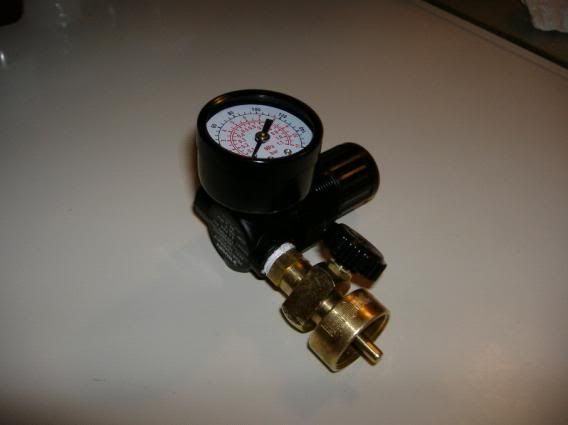
Here is a picture of the propane regulating valve I made the other day for use on my upcoming project.
<img src="http://i10.photobucket.com/albums/a123/ ... /PRIVS.jpg">
This technique probably seals better than the hosing idea, and looks a lot better too. I tested it with some soap water and found no leaks. I'm pretty sure a piece of hosing would leak if you just clamped it onto the torch shaft, (unless you did it right, with two clamps with the heads on opposite sides).
That's it!
But why?
There exists a simple method to get a portable LP tank to a torch valve to pipe threads and fittings. May people are turned off by the so called "pretty" methods because they involve a lot of work and buying a 1/8" NPT thread die. But a simpler way yet exists to connect a propane torch valve to pipe threads and fittings.
First off, I do <B>not</B> claim credit for these ideas. I <I>believe</I> it was SpudMonster who did it first, (but I can't be sure...). So don't think I'm stealing any ideas, I just couldn't find anything on this site about doing it.
All that is required to perform this adaptation is a BernzOmatic or Craftsman torch head, (I have only done it with these two), a 1/4" mnpt x 1/4" compression nut, some vise grips, and a large adjustable wrench or a pipe wrench, (needed for Craftsman...). Also, some plastic to protect the torch and the brass from machine burrs is prudent also.
First, you need to remove the torch shaft from the propane input, (needle), valve. Unscrew the air hole sleeve. Next, grip the torch valve itself with the adjustable wrench, (BernzOmatic torches have the nice rectangular part to make this a cinch), or a pipe wrench for the Craftsman torch head, (this will produce machine marks). Then, tighten the vice grip over the torch shaft, (before the bend, near the valve), and make sure to get it as tight as your strength allows.
Now, torque off the torch shaft from the valve, (where it is threaded in with a Loc-Tite-type sealant). This will take some effort, and will leave red residue in the female threads of the torch valve that need to be removed.
Now, take a good look at your compression nut. Compression nuts are used to connect pipe threads to copper tubing, (measured by O.D.). In this design, you are not connecting tubing to threads, you are connecting threads to threads. One side of the nut has standard 1/4" mnpt threads, for connecting to pipe fittings. The other has a brass nut. Inside the nut, there is an olive shaped sleeve. In some, there is a little brass tube running through the thing and out the nut.
Unscrew the nut on this end and remove the olive nut and tube thingy if there is one. This will leave you with some threads that are skinnier than the 1/4" mnpt threads.
These will screw into the torch valve, although they are straight. This means you need to wrap them in about 5 wraps of teflon tape, and then screw in ALL THE WAY until it bottoms to get a good seal.
After this, you can either connect the 1/4" mnpt threads to a regulator, or your meter, if it is hand-regulated.
Here is a picture of the propane regulating valve I made the other day for use on my upcoming project.
<img src="http://i10.photobucket.com/albums/a123/ ... /PRIVS.jpg">
This technique probably seals better than the hosing idea, and looks a lot better too. I tested it with some soap water and found no leaks. I'm pretty sure a piece of hosing would leak if you just clamped it onto the torch shaft, (unless you did it right, with two clamps with the heads on opposite sides).
That's it!

 Maybe when I get started on my cousin's Christmas gift. Might be a little cheaper than a torch.