Tapping: Difference between revisions
Jump to navigation
Jump to search
Metalmeltr (talk | contribs) No edit summary |
Metalmeltr (talk | contribs) No edit summary |
||
| Line 17: | Line 17: | ||
==='''The Process'''=== | ==='''The Process for metal'''=== | ||
#Mark and drill an appropriately sized hole | #Mark and drill an appropriately sized hole | ||
#*The hole should be in an area where fittings or pipe overlap (double thickness)[[Image:ReltonRapidTap.jpg|right|thumb|An appropriate cutting fluid for tapping holes. It is usually available at tool stores. ]] | #*The hole should be in an area where fittings or pipe overlap (double thickness)[[Image:ReltonRapidTap.jpg|right|thumb|An appropriate cutting fluid for tapping holes. It is usually available at tool stores. ]] | ||
| Line 30: | Line 30: | ||
#*For tapered threads, stop as soon as the entire length of the hole is threaded | #*For tapered threads, stop as soon as the entire length of the hole is threaded | ||
'''Process for plastic''' | |||
When taping into plastic a pipe tap is unessasary. | |||
#Drill hole slightly smaller than your fitting. | |||
#Hold your fitting with a wrench and slowly turn it into the plastic, be sure to keep it straight. | |||
#After the fitting is threaded in completly remove the fitting. | |||
#Wrap teflon tape around the threads | |||
#Thread the fitting back into your hole. | |||
== external links == | == external links == | ||
[http://www.wikihow.com/Use-a-Tap wikihow's article on tapping] | [http://www.wikihow.com/Use-a-Tap wikihow's article on tapping] | ||
[[Category:Construction methods]] | [[Category:Construction methods]] | ||
Latest revision as of 10:29, 27 December 2010

Tapping is the process of cutting threads on the inside diameter of a hole with a tool called a tap. It is used to thread holes for mounting:
- Pressure gauges
- Fuel meters
- Electrodes (Bolts)
- Safety valves
- Other
Types of Threads
There are a few different thread systems that are used in spudgun construction
- NPT (National Pipe Taper)
- BSP (British Standard Pipe)
- NF (National Fine)
- NC (National Course)
The Process for metal
- Mark and drill an appropriately sized hole
- The hole should be in an area where fittings or pipe overlap (double thickness)
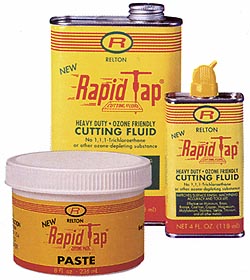
An appropriate cutting fluid for tapping holes. It is usually available at tool stores. - Find correct hole size with a Tap/Drill Chart
- The hole should be in an area where fittings or pipe overlap (double thickness)
- Insert the tap into the tap wrench
- If you don't have a tap wrench, a normal crescent wrench can be used
- Cut the threads
- Be careful to keep the tap straight or you will end up with crooked threads
- When tapping plastic (or any other material) be sure to use an appropriate cutting fluid such as RapidTap® made by Relton.
- Apply downward pressure while slowly turning the tap clockwise 180 degrees, then back out 90 degrees counterclockwise to clear the chips
- For tapered threads, stop as soon as the entire length of the hole is threaded

Process for plastic
When taping into plastic a pipe tap is unessasary.
- Drill hole slightly smaller than your fitting.
- Hold your fitting with a wrench and slowly turn it into the plastic, be sure to keep it straight.
- After the fitting is threaded in completly remove the fitting.
- Wrap teflon tape around the threads
- Thread the fitting back into your hole.