update page 2 how much fps you think !!!
-
inonickname

- First Sergeant 4

- Posts: 2606
- Joined: Sun Dec 07, 2008 3:27 am
Jack, I'd have thought a marble/granite block? Only saying because from experience, a lot of perfect calibrated level surfaces for mills are marble/granite or similar.
PimpAssasinG wrote:no im strong but you are a fat gay mother sucker that gets raped by black man for fun
-
jackssmirkingrevenge

- Five Star General

- Posts: 26219
- Joined: Thu Mar 15, 2007 11:28 pm
- Has thanked: 582 times
- Been thanked: 348 times
It has a granite face but that's mounted on a substantial concrete block.inonickname wrote:Jack, I'd have thought a marble/granite block?
-
jimmy101

- Sergeant Major 2


- Posts: 3211
- Joined: Wed Mar 28, 2007 9:48 am
- Location: Greenwood, Indiana
- Has thanked: 7 times
- Been thanked: 18 times
- Contact:
Usually, any scale that is accurate to 1mg or less will have an enclosure. In addition, it'll usually be mounted on something massive, like a 4" thick by 2'x2' hunk of marble. With that setup it'll stabilize almost instantly when a mass is placed on the pan and wind currents (people walking about, the rooms AC etc) won't affect it.Ragnarok wrote:If you need 0.001 gram precision, expect serious money. Also, expect it to fluctuate any time anyone moves anywhere within the room.
The standard analytical laboratory scale is accurate to about 0.01mg. It'll always have an enclosure. Usually the maximum weight is about 30g for 0.01mg resolution, ~500g for 0.1mg resolution. Here is a photo of an analytic scale used in thousands of labs around the world. Relatively cheap ($2500~$5000) for a lab grade instrument and very robust. Much cheaper and much more robust than the older designs that used actual weights and a ruby knife edge as the fulcrum.
The mid sensitivity scales are typically +/- 1mg and will usually also have an enclosure, though the enclosure is often much simpler than with the precision scales. Mass limits of 500g or so are common.
Micro scales will go down another order of magnitude or so in senstivity compared to analytic scales. Figure 0.001mg or so but with a fairly low maximum weight, perhaps as little as a gram.
It is pretty rare to need accuracy and resolution below about 0.01mg. A single small grain of salt weighs about that much. A moist finger print weighs more than that so you must be careful in how you handle the sample and it's container. At the 0.01mg scale things like moisure absorption from the air start to become a problem, the sample will slowly drift up in weight as it picks up water, or drift down in weight if it is moist.
For a spudder, a good balance would be one of the cheap digital postal scale type electronic top loaders. Harbor freight has a couple for $20:
http://www.harborfreight.com/cpi/ctaf/d ... mber=93543 with 0.1g resolution and
http://www.harborfreight.com/cpi/ctaf/d ... mber=95364 with 1g resolution.

-
Technician1002
- Captain

- Posts: 5189
- Joined: Sat Apr 04, 2009 11:10 am
The faster you push an object through water the higher the energy transfer to the mass that must be moved out of the way of the projectile. A high speed projectile doesn't simply "punch a hole" in the water and leave the water still. The water displaced by a higher speed projectile receives more kinetics energy than from a slower projectile. This high energy water is moving with lots of kinetic energy. This transfer if energy to the fluid is why bullets don't travel very far when shot into water. This explosive force makes cans explode at higher speeds. The faster the projectile the higher the impact forces and the higher the energy transfer.jackssmirkingrevenge wrote:I disagree there, the more the hole resembles the projectile's shape, then the faster it has to be going. Increasing velocity decreases the time which the target material has to distort and absorb the impact so the projectile simply punches straight through.Technician1002 wrote:The fact that it made a hole the shape of the projectile indicates fairly slow speeds. The impact shock wave energy distorts the impact site at higher speeds as high amounts of energy is transfered in the impact.
In this case however, we are talking about a water-filled container, so there are other forces at work here, by virtue of an incompressible fluid which is being displaced by the travel of the projectiles.
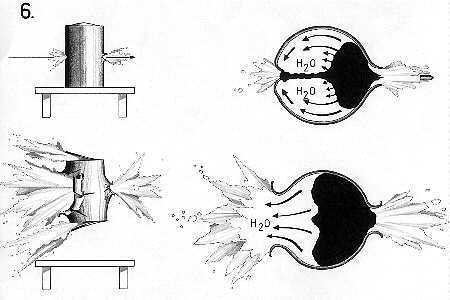
This Mythbusters episode covers the fact that the high speed high energy bullets lost lots of energy passing through water.
http://www.tv.com/mythbusters/bullet-pr ... ecap;recap
There is a transfer of energy. It goes somewhere. At higher speed the results are explosive.

I don't think it was going very fast, if you watch closely you can see it bouncing off the can going to the left, its a really quick metallics blur. The screw never even goes into the can, let alone knock the board down. The water/can knocked over the board.


i think you are right (not about the I don't think it was going very fast) ,there is a point in your wordsadem70 wrote:I don't think it was going very fast, if you watch closely you can see it bouncing off the can going to the left, its a really quick metallics blur. The screw never even goes into the can, let alone knock the board down. The water/can knocked over the board.
soon i will post a video shooting water full can (in the center)

edit ::
i watch the video more carefully and i notice that the screw hit the flat wood before the can
see


i need to adjust the sight
Last edited by far_cry on Sat Aug 29, 2009 3:27 am, edited 1 time in total.





How could that hole be caused by the shot when it is there before you even fired?
Or am I not seeing something correctly?
Or am I not seeing something correctly?
witch hole did you mean ?if you talk about the one in the thick mdf board .yes it was a hole but the screw damage the wood also
here what happens exactly
i shoot the screw too low ,and he hits the thin board"there is a hit in the middle of the circle in the picture the second one " where the can sitting
and jumps off a little bit and hit the can in the bottom left side, and finally he hits the mdf wood .the thick one
the screw did not go through the can at all.because of this there was no shock waves in the water that rip open the can
here what happens exactly
i shoot the screw too low ,and he hits the thin board"there is a hit in the middle of the circle in the picture the second one " where the can sitting
and jumps off a little bit and hit the can in the bottom left side, and finally he hits the mdf wood .the thick one
the screw did not go through the can at all.because of this there was no shock waves in the water that rip open the can
Your red circle should be up further or smaller so you don't include that knot hole or maybe just use an arrow.
After I ignored your red circle , I saw it right away.
Now I understand!
After I ignored your red circle , I saw it right away.
Now I understand!
i made another test
in the video you will see that if i shoot the screw in backward will do more damage
distance was 6 meters ,and the camera post was near the shooting
look at the first shot ,red bull can get shot with the screw tip .and the other 2 shots with the head(different damage)
[youtube][/youtube]
in the video you will see that if i shoot the screw in backward will do more damage
distance was 6 meters ,and the camera post was near the shooting
look at the first shot ,red bull can get shot with the screw tip .and the other 2 shots with the head(different damage)
[youtube][/youtube]
Create an account or sign in to join the discussion
You need to be a member in order to post a reply
Create an account
Not a member? register to join our community
Members can start their own topics & subscribe to topics
It’s free and only takes a minute
Sign in
-
- Similar Topics
- Replies
- Views
- Last post
-
- 71 Replies
- 29189 Views
-
Last post by Sticky_Tape
-
- 2 Replies
- 3117 Views
-
Last post by saladtossser
-
- 7 Replies
- 16472 Views
-
Last post by Ellyanderson
-
- 7 Replies
- 12567 Views
-
Last post by Doodmens
-
- 20 Replies
- 7047 Views
-
Last post by Labtecpower