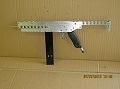
Not much "QB" left in my QB.

Old pic before that last round of changes...


Your Potato Cannon Community





Yep. Still looks good though, ehbeastmode986 wrote:THAT IS FREAKING CHINESE!!!
hectmarr wrote:You have to make many weapons, because this field is long and short life
jackssmirkingrevenge wrote:Yep. Still looks good though, ehbeastmode986 wrote:THAT IS FREAKING CHINESE!!!





don't want to get into a big debate so I'll just say this: Not necessarily. There are many, many variables at play. Sometimes heavy, slower projectiles will penetrate deeper. It all depends....jackssmirkingrevenge wrote:Also note that for a given energy, a smaller faster projectile will generally penetrate deeper than a larger slower one, even though it will make a smaller hole.
Hence the "generally"D_Hall wrote:don't want to get into a big debate so I'll just say this: Not necessarily. There are many, many variables at play. Sometimes heavy, slower projectiles will penetrate deeper. It all depends....
JSR in a debate about energy and momentum wrote:Penetration is a function of many things. If there's one area of research where the search for better penetration is most intense, it's in the field of anti-tank weapons, namely those that function mechanically as opposed to relying on explosives.
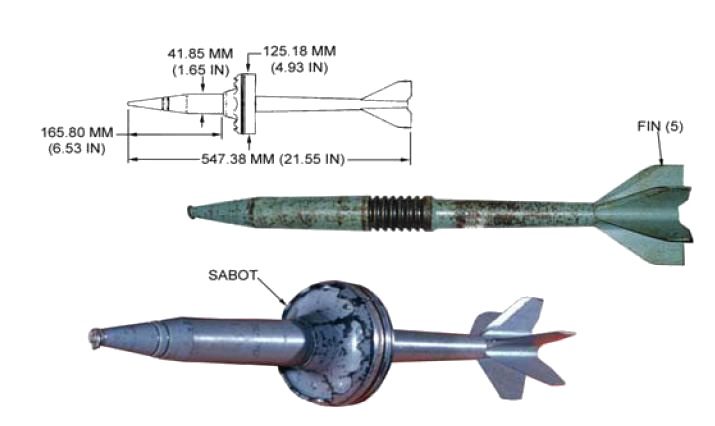
Let's take an advanced projectile as an example, here's a Soviet 125mm APFSDS round:
In order to achieve optimal penetration, the following parameters are important:
1) high velocity - if a projectile travels slowly, the target will have time to deform and absorb the blow without penetration, and therefore in order to penetrate well you need as high a velocity as possible. A typical anti-tank round is travelling at around 5,000 fps.
2) high sectional density - in order to maintain its momentum, and transfer the energy in a concentrated manner, you need a projectile that is as heavy and narrow as possible - this is why APFSDS rounds are made of very dense materials such as tungsten or depleted uranium, which being long and thin to give the distinctive arrow shape.
3) high projectile hardness - nature will always choose the path of least resistance, so if the target material is tougher than the projectile, the impact energy will go towards shattering or deforming the projectile as opposed to the target.
A simple comparison is to look at typical airguns in the UK, which are legally limited to the same kintetic energy of 12 ft/lbs.
A typical 0.22 pellet weighing 16 grains travels at 581 fps for 12 ft/lbs.
A typical 0.177 pellet weighing 8 grains travels at 822 fps for 12 ft/lbs.
The 0.177 pellet only has 70% of the momentum of the 0.22 pellet, but will penetrate further by virtue of its higher velocity and smaller diameter.
hectmarr wrote:You have to make many weapons, because this field is long and short life
Out of the box, certainly. But it turns out that you actually *can* polish a turd!Gippeto wrote:It's not a Daystate...

hectmarr wrote:You have to make many weapons, because this field is long and short life
You need to be a member in order to post a reply
Not a member? register to join our community
Members can start their own topics & subscribe to topics
It’s free and only takes a minute