Piston Gap Drawing

Cannons powered by pneumatic pressure (compressed gas) using a valve or other release.
User avatar
dewey-1
Sergeant 3
Sergeant 3
Posts: 1298
Joined: Wed Mar 28, 2007 10:24 am
Location: NE Wisconsin USA

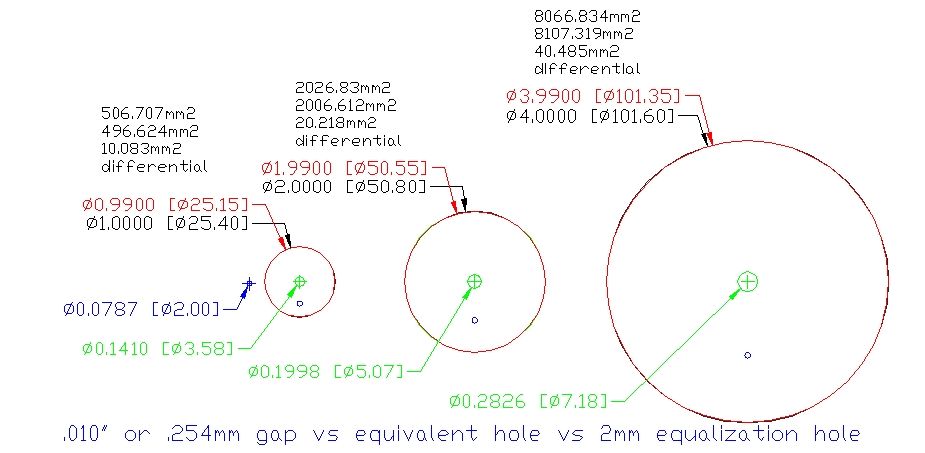
This drawing is made to give people an idea of what a 1mm gap looks equivalent to in a 1, 2 and 4 inch diameter.
Note dimensions are Imperial with Metric in brackets.

A 1 mm gap is quite large when you calculate the actual total.
The Red is piston OD.
The Green is the total equivalent area of a 1 mm gap around the piston.
The Blue is a 2 mm equalization hole for comparison.

For example; the equalization hole is .080" or 2mm in a typical 1" sprinkler valve.

This comparison should give you an idea how really large a 1 mm gap is!

Image

Here is the drawing with .25mm or .0098" gap for comparison.
You will notice a huge difference.

Image

edit; add .25mm gap drawing, fix first 4" circle gap to 3.9606" & calculations
Last edited by dewey-1 on Sun Aug 30, 2009 12:16 pm, edited 4 times in total.
User avatar
Technician1002
Captain
Captain
Posts: 5189
Joined: Sat Apr 04, 2009 11:10 am

That is a fantastic summary of why many piston valves fail to open. The size of the porting past the piston is underestimated. Well done. For close ratio pistons (seat diameter to OD), this leakage must be tightly controlled, otherwise, the pilot area can't drop in pressure enough to unseat the piston. The chamber pressure just blows into the pilot area.
User avatar
dewey-1
Sergeant 3
Sergeant 3
Posts: 1298
Joined: Wed Mar 28, 2007 10:24 am
Location: NE Wisconsin USA

Tech;

What is your equalization hole size in your 2" piston? I am guessing around
.0625" to .080". (1.59 to 2.00 mm)

I may do another drawing to show a .25mm or .010" gap for a more realistic picture.
User avatar
Technician1002
Captain
Captain
Posts: 5189
Joined: Sat Apr 04, 2009 11:10 am

dewey-1 wrote:Tech;

What is your equalization hole size in your 2" piston? I am guessing around
.0625" to .080". (1.59 to 2.00 mm)

I may do another drawing to show a .25mm or .010" gap for a more realistic picture.
My 2 inch piston is a QDV, so the piston is not using a pilot. The pilot area is never under pressure, so it can't be vented to fire the cannon. The QDV valve seat and piston OD is the same size.

The Mouse Musket is using a 1 inch barrel, so the piston is 1.5 in diameter. The EQ hole is 1mm.

The Mouse Musket is a 1 inch barrel 2 inch chamber coaxial. The piston rides in a very short length of 1.5 inch pipe in a 1.5 inch female adaptor swedged into the end of the 2 inch chamber. This is built that way to make the piston ratio a close ratio piston as the valve seat is larger than the bore of the barrel. The valve seat is an o ring on the outside of the barrel held in place by a coupler grooved to hold the ring.

Until it broke and I built the QDV, this was my best performing cannon. It put 1 inch gumballs through 1/2 inch sheets of plywood. The valve is very fast and opens with a POW.

The Dragon cannon, my other piston cannon is 2.5 inch porting with a 3 inch piston in a 6 inch chamber. A reducer is used to reduce the 6 inch to 4 inch. A female 3 inch adapter was used to hold the 3 inch section of pipe in the adapter for the piston, so the dragon is another close ratio piston. Due to the size, it tended to either not work or break things. An inverted 2.5 inch pipe cap was used for pistons. The PVC didn't like the forces and pistons were short in life expectancy. This cannon is retired due to the difficulties keeping it working. The Dragon used an o ring in the piston cylinder for a seal instead of on the piston.

A 3 inch QDV in a propane tank will replace the Dragon.
Attachments
Musket seat. 1.5 inch valve cylinder, 1 inch barrel, 1.25 inch valve seat make a close ratio valve.
User avatar
dewey-1
Sergeant 3
Sergeant 3
Posts: 1298
Joined: Wed Mar 28, 2007 10:24 am
Location: NE Wisconsin USA

Tech;

My thinking for optimal operation for 1, 2, 3 & 4 inch pistons would have equalization hole sizes that would correspondingly be 1, 2, 3 & 4 mm with maybe a max of .25mm gap to allowed for grease/lubricant.

What do you think or any one else, before I do a realistic drawing?

Pistons with O-ring seals may require a slightly larger hole.

These sizes are just a starting point to prevent to large of a hole.
jeepkahn
Corporal 3
Corporal 3
Posts: 747
Joined: Fri Jan 09, 2009 1:11 pm
Location: Triad, NC, USA

other than for filling from the chamber side, what purpose does an EQ hole serve? A properly designed checking piston that allows filling past the piston is way too easy to construct...
My Cannons can be found by clicking the following link.
http://www.spudfiles.com/forums/viewtop ... tml#256896
User avatar
jrrdw
Moderator
Moderator
United States of America
Posts: 6572
Joined: Wed Nov 16, 2005 5:11 pm
Location: Maryland
Has thanked: 39 times
Been thanked: 22 times
Contact:

jeepkahn wrote:other than for filling from the chamber side, what purpose does an EQ hole serve? A properly designed checking piston that allows filling past the piston is way too easy to construct...
It's for filling from the pilot side.
User avatar
dewey-1
Sergeant 3
Sergeant 3
Posts: 1298
Joined: Wed Mar 28, 2007 10:24 am
Location: NE Wisconsin USA

I updated the original post to show a .25mm piston gap to compare how much of a difference there really is!
User avatar
MrCrowley
Moderator
Moderator
Posts: 10078
Joined: Fri Jun 23, 2006 10:42 pm
Location: Auckland, New Zealand
Been thanked: 3 times

Great topic, you should put this on the Wiki for easier referencing.
User avatar
Technician1002
Captain
Captain
Posts: 5189
Joined: Sat Apr 04, 2009 11:10 am

jeepkahn wrote:other than for filling from the chamber side, what purpose does an EQ hole serve? A properly designed checking piston that allows filling past the piston is way too easy to construct...
As the chamber pressure changes as it is filled, without an eq hole or some intentional piston leakage, the pilot area starts without pressure. Without EQ it is impossible to pressurize the chamber as doing so will open the valve.

EQ can be provided either internal to the valve, usualy with a "leaky seal" or eq port in the piston. It can be external through an eq valving external to the cannon.
User avatar
King_TaTer
Specialist 2
Specialist 2
Posts: 265
Joined: Fri Nov 17, 2006 6:14 pm

Shouldn't the 4 inch piston in the first diagram have a diameter of 100.60mm instead of 99.60mm? It would also make the piston diameter in imperial change to 3.9606", no? Right now it's showing that there is a 2mm gap when it should only be 1, correct?

Good drawings though. I intend to use a check valve and o-rings for my barrel sealing piston, to alleviate the need for such precision.
Materials links:
<a href="http://www.discounthydraulichose.com/">Discount Hydraulic Hose</a>
<a href="http://www.buyfittingswholesale.com/#">Buy fittings wholesale</a>
<a href="http://www.flexpvc.com/">Flex PVC</a>
<a href="http://www.murrayequipment.com">MEI
</a>
User avatar
dewey-1
Sergeant 3
Sergeant 3
Posts: 1298
Joined: Wed Mar 28, 2007 10:24 am
Location: NE Wisconsin USA

King_TaTer wrote:Shouldn't the 4 inch piston in the first diagram have a diameter of 100.60mm instead of 99.60mm? It would also make the piston diameter in imperial change to 3.9606", no? Right now it's showing that there is a 2mm gap when it should only be 1, correct?
Correct!

Thank you for catching my blunder!

The drawing and the original posting have been just corrected.
User avatar
Insomniac
Sergeant 3
Sergeant 3
Posts: 1297
Joined: Mon Dec 18, 2006 3:47 pm
Location: Australia

Good drawings, but it isn't quite a fair comparison. The area of the gap and the drawn hole may be the same, but the narrow gap will restrict airflow alot more than a hole of the same area.
I wonder how much deeper the ocean would be without sponges.
Right now I'm having amnesia and deja vu at the same time. I think I've forgotten this before.

Add me on msn!!! insomniac-55@hotmail.com
User avatar
Technician1002
Captain
Captain
Posts: 5189
Joined: Sat Apr 04, 2009 11:10 am

Insomniac wrote:Good drawings, but it isn't quite a fair comparison. The area of the gap and the drawn hole may be the same, but the narrow gap will restrict airflow alot more than a hole of the same area.
That is true that the long slot will flow more poorly than a round hole. The point of this thread is to point out that the small slot can have a very large area and prevent the operation of piston valves in larger size cannons.

This thread reminds me of the design of steam whistles. They also have a very small gap.

Church pipe organs have a little larger gap, but they operate at very low pressure. Many operate in the 6 inch water column pressure range. Some operated with less than 3 inches water column pressure.

http://en.wikipedia.org/wiki/Pipe_organ
Post Reply

Create an account or sign in to join the discussion

You need to be a member in order to post a reply

Create an account

Not a member? register to join our community
Members can start their own topics & subscribe to topics
It’s free and only takes a minute

Register

Sign in

  • Similar Topics
    Replies
    Views
    Last post
  • QEV Drawing
    by velocity3x » » in Pneumatic Cannons
    7 Replies
    1636 Views
    Last post by velocity3x
  • Drawing Software
    by M.J.P. » » in Off-Topic Hobbies
    11 Replies
    3293 Views
    Last post by CS
  • Drawing of new Airgun
    by FreaK_with_GuN » » in Pneumatic Cannons
    11 Replies
    4588 Views
    Last post by inonickname
  • Conceptual Drawing
    by SNDM » » in BB, Airsoft, and Pellet Guns
    10 Replies
    4200 Views
    Last post by SEAKING9006
  • air cannon on the drawing board
    by MrDEB » » in Pneumatic Cannons
    7 Replies
    2505 Views
    Last post by Hubb