boyntonstu wrote:
Thanks,
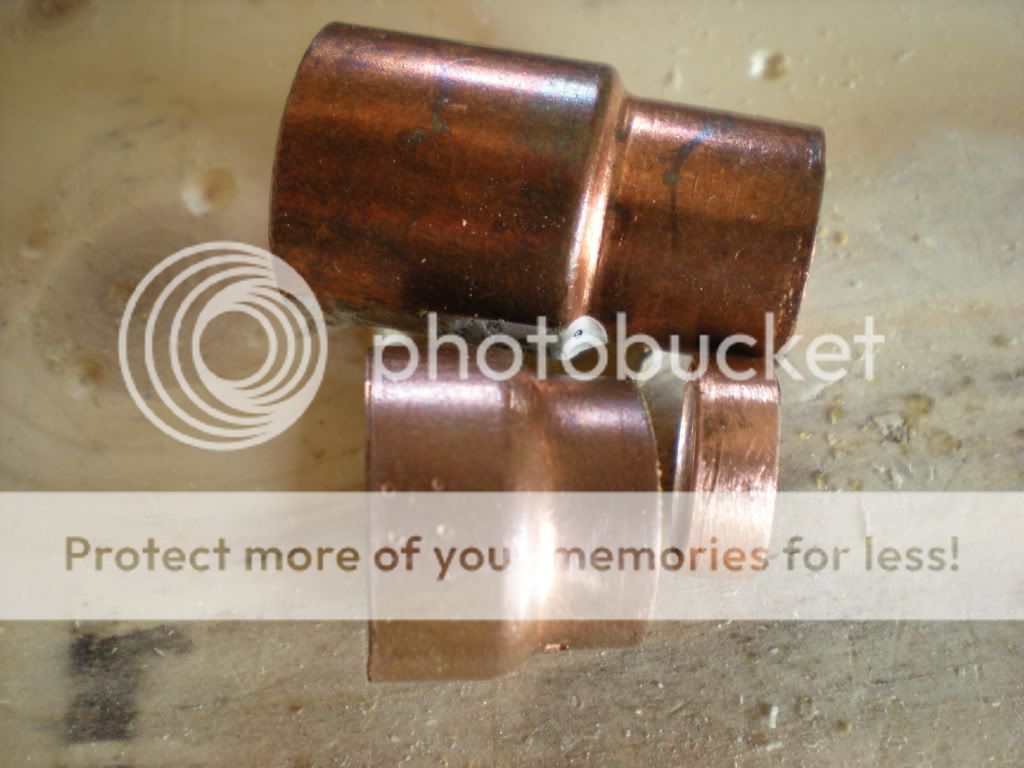
The 3/4 > 1/2 fitting reducer edge could be made thicker by soldering a 1/4" length of 1/2" copper tubing and smoothing the edge. Agree?
Agreed. Smooth edges are a plus. Thicker in areas of stress and fatigue are a plus.
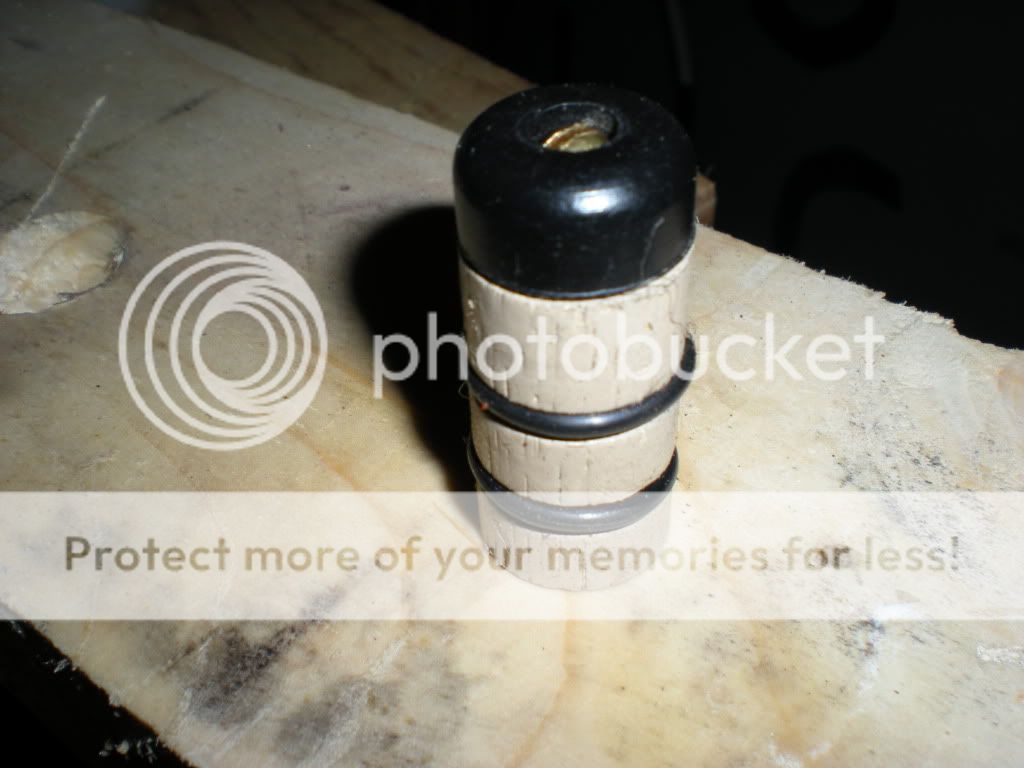
The barrel insert uses an O ring piston epoxied to the copper.
Should the hose clamps slip I can use several other designs to hold the insert with greater force.
Chamber diameter vs chamber outlet diameter.
If a 2" chamber is necked down to fit the 3/4" T, would the flow rate be higher than a straight 3/4" chamber.
Flow rate is often mis-understood. I had major problems with you can't go supersonic with just compressed air. The max flow out of a chamber through an orifice can only be sonic. That bugged me. At high pressure the air traveling sonic is more dense as it is at higher pressure. Bingo. More air mass goes through, but the speed is only sonic at max. Then it expands if unrestricted and goes SUPERSONOC. Woo hoo.
With that in mind a long chamber can empty out into a barrel at sonic speeds. A long chamber will have lower pressure at the transition. A shorter chamber larger in diameter will have less pressure drop going into the barrel. It seems possible the mass into the barrel will be faster, to then apply the pressure on the projectile.
My plan is to use 400-600+ psi as George has proven.
I plan on using a 38" long 3/4" (0.811") barrel. 19.58 cu in.
What length/volume chamber at 400 psi would suffice to accelerate a projectile 38"?
Thanks,
BoyntonStu
My recommendation is to work backwards from the desired pressure behind the projectile at barrel exit and work volume backwards.
Say minimum pressure that will still be accelerating at near 1100 FPS is 50 PSI due to windage, then figure the total volume barrel and chamber that will provide that exit pressure. Allow some more for flow resistance and the thermal change. GGDT will model the various chamber barrel combinations to provide the rough minimum chamber size. Some of my designs are showing gas temperature drops of over 100 degrees F.
Many of your other replies are excellent also. Too many to answer all in one post.