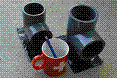
I going to test it someday
Homemade pressure regulator
- ShowNoMercy
- Sergeant

- Posts: 1094
- Joined: Mon Mar 19, 2007 8:08 am
- Location: Jersey Bitches!
Thats already invented though.... steam plants used to use something like that. Old ones still do.
Jesus saves, no need to pray
The gates of pearl have turned to gold
It seems you've lost your way
The gates of pearl have turned to gold
It seems you've lost your way
- Brian the brain
- Moderator


- Posts: 3497
- Joined: Mon Dec 05, 2005 2:06 am
- Location: Holland
- Been thanked: 7 times
If the pressure in the system overcomes the power of the spring ( on top of the piston) the ballvalve is closed.
The power of the spring determines at what pressure the inlet is closed, So yes..in theory this works
Gun Freak wrote:
Oh my friggin god stop being so awesome, that thing is pure kick ass. Most innovative and creative pneumatic that the files have ever come by!
Can't ask for a better compliment!!
Oh my friggin god stop being so awesome, that thing is pure kick ass. Most innovative and creative pneumatic that the files have ever come by!
Can't ask for a better compliment!!
When the pressure increases, the piston is pushed back wich closes the valve more and more._Fnord wrote:Am I the only one that doesn't have a clue how that diagram is supposed to work?
Anyone care to explain it to someone who just got up?
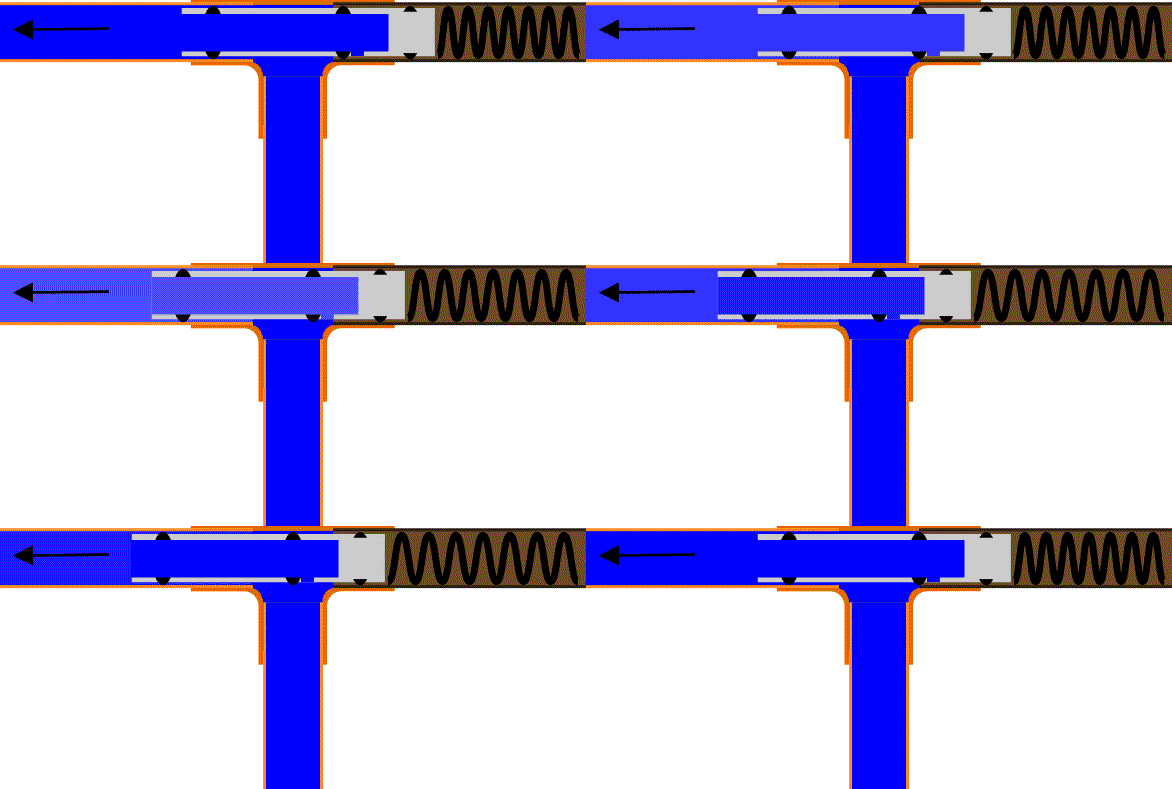
The valve will be completely closed at a given pressure.
When the pressure drops the piston is pushed back by the spring and opens the valve again, letting air flow in, increasing the pressure.
I think it's going to have difficulties with the mechanical linkage between the valve and feedback system- try this for a design, which combines both parts into one:

Should be pretty self explanatory - and it's clearly missing a stop to stop the main component shooting out if the pressure falls too low, I know that - come on, I drew it up in a few minutes - but it is something I designed ages ago.
I have a better design on the same principle that would be more reliable and have better flow control, but that would take longer to draw up - still, I plan to make it soon to try and convert HEAL for faster reloading... oh crap, I didn't mean to say that yet*
I have lots of other designs for pressure driven valves, including an automatic venting and metering system for a combustion. I'm not giving away exact details, but you may be able to make a couple of mental leaps to get the basic principles.
*Yes, I am fully aware that I could have deleted it before posting, and therefore I said it completely deliberately, whoever tries to tell me that (probably JSR I would imagine).
Still, I may go even further sometime, bringing back part of my colossally old "Timberwolf" designs that still need to see the light of day and make a shell ejecting semi-auto setup as well.

Should be pretty self explanatory - and it's clearly missing a stop to stop the main component shooting out if the pressure falls too low, I know that - come on, I drew it up in a few minutes - but it is something I designed ages ago.
I have a better design on the same principle that would be more reliable and have better flow control, but that would take longer to draw up - still, I plan to make it soon to try and convert HEAL for faster reloading... oh crap, I didn't mean to say that yet*
I have lots of other designs for pressure driven valves, including an automatic venting and metering system for a combustion. I'm not giving away exact details, but you may be able to make a couple of mental leaps to get the basic principles.
*Yes, I am fully aware that I could have deleted it before posting, and therefore I said it completely deliberately, whoever tries to tell me that (probably JSR I would imagine).
Still, I may go even further sometime, bringing back part of my colossally old "Timberwolf" designs that still need to see the light of day and make a shell ejecting semi-auto setup as well.
Last edited by Ragnarok on Tue Nov 20, 2007 3:45 pm, edited 1 time in total.
Does that thing kinda look like a big cat to you?
So now all you have to do is add an adjustment screw at the non valve side of the spring and you have yourself a fully ajdjustable air regulator, cool beans
<a href="">DONT TAZE ME BRO.. DONT TAZE ME... AHHHH</a>Yea, that's definitely going to get you at least a tazer.
facebook.com/biggrib
That idea is pretty simple, but simple usually means reliable, or at least, easier to fix.
Using some bushings and a larger tee, you can make it a bit more reliable again, and make it more precise by controlling the flow better as it approaches the set operating pressure. I'll scrawl a copy up later.
Does that thing kinda look like a big cat to you?
Hi,
Try to look at a diving regulator:
http://en.wikipedia.org/wiki/Diving_regulator
(the drawing with the caption: Diagram of the internal components of a piston-type first stage)
This can be simplified somewhat, to avoid having to seal the outside of the moving stem pipe... see my drawing.
When the intermediate pressure is too low, it can´t prevent the spring from pushing the valve open --> intermediate pressure rises.
When the intermediate pressure is too high, it will push down harder on the piston, overcoming the force of the spring and closing the valve.
The problem with the ball valve set-up is that it requires a lot of movement to control the ball valve. It will need a very long and very stiff spring. On the other hand, "my" design also is influenced a little by the force of the high pressure on the valve - a ball valve is not. If the piston in my drawing is large enough compared to the valve seat diameter, it won´t really matter though.
Regards
Soren
Regards
Soren
Try to look at a diving regulator:
http://en.wikipedia.org/wiki/Diving_regulator
(the drawing with the caption: Diagram of the internal components of a piston-type first stage)
This can be simplified somewhat, to avoid having to seal the outside of the moving stem pipe... see my drawing.
When the intermediate pressure is too low, it can´t prevent the spring from pushing the valve open --> intermediate pressure rises.
When the intermediate pressure is too high, it will push down harder on the piston, overcoming the force of the spring and closing the valve.
The problem with the ball valve set-up is that it requires a lot of movement to control the ball valve. It will need a very long and very stiff spring. On the other hand, "my" design also is influenced a little by the force of the high pressure on the valve - a ball valve is not. If the piston in my drawing is large enough compared to the valve seat diameter, it won´t really matter though.
Regards
Soren
Regards
Soren
- Attachments
-
- Too late for a patent, but here it is.
- regulator.PNG (7.68 KiB) Viewed 3094 times
Create an account or sign in to join the discussion
You need to be a member in order to post a reply
Create an account
Not a member? register to join our community
Members can start their own topics & subscribe to topics
It’s free and only takes a minute
Sign in
-
- Similar Topics
- Replies
- Views
- Last post
-
- 20 Replies
- 16526 Views
-
Last post by jean
-
- 6 Replies
- 2797 Views
-
Last post by apocavorme
-
- 14 Replies
- 5161 Views
-
Last post by Antonio
-
- 5 Replies
- 2450 Views
-
Last post by Gippeto
-
- 2 Replies
- 1292 Views
-
Last post by shud_b_rite